
This post may contain affiliate links, which means I’ll receive a commission if you purchase through my links, at no extra cost to you. Please read my full disclosure for more information.
“A Theory of Dreaming” is the sequel to the book A Study in Drowning, continuing the story of Effy Sayre and her academic nemesis-turned-lover, Preston Héloury.
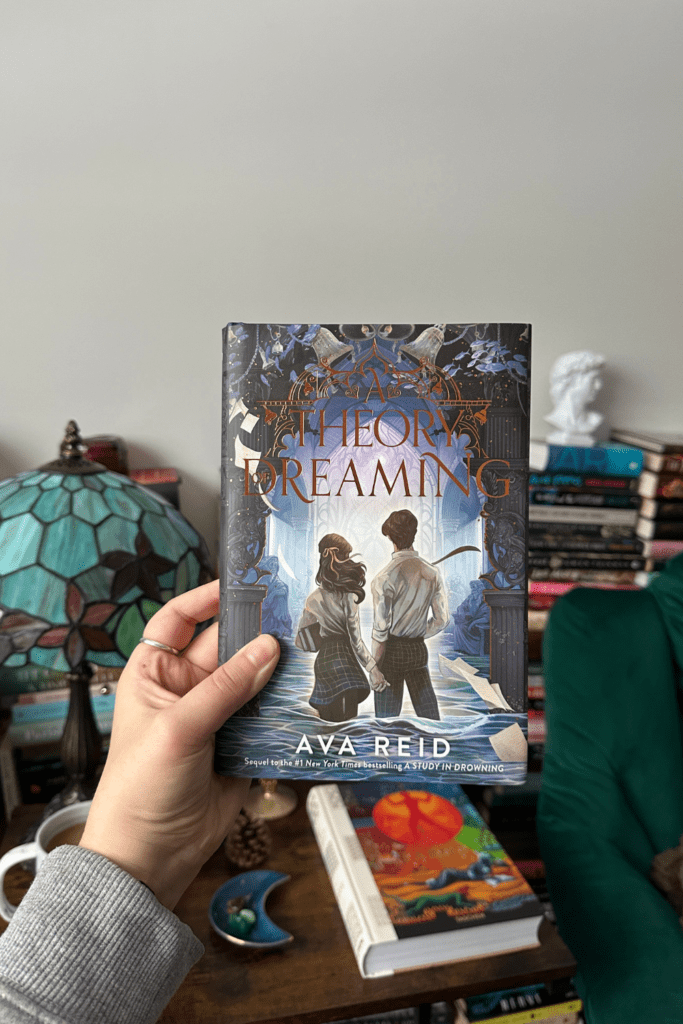
- Date finished: November 12th, 2025
- Pages: 416
- Format: Hardback
- Form: Fiction
- Language read: English
- Series: A Study in Drowning
- Genre: Fantasy | Dark Academia | Young Adult
In “A Theory of Dreaming,” we follow Effy’s struggle as the first female student enrolled in Llyr’s Department of Literature. Added to that pressure, Effy has to face the bleak reality of life without the illusory comfort of dreams. Meanwhile, Preston is fighting his own battles. On the one hand, he’s trying to keep Effy afloat while his own dreams of a palace under the sea are threatening to claim him and the one he loves most.
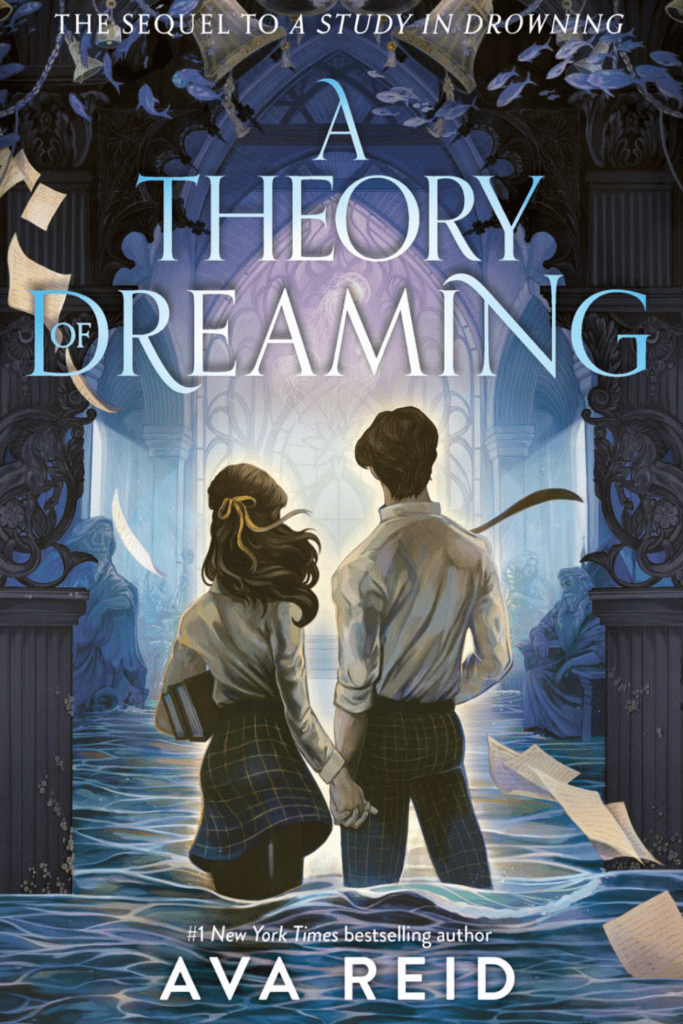
Although “A Theory of Dreaming” is written in dual POV, this is undoubtedly Preston’s book. The border between truth and reality becomes increasingly porous in this next installment as we witness Preston’s dream-like drift into an alluring palace under the sea.
“You really are desperately loyal to this notion of truth,” Gosse said at last, in a tone that suggested both fondness and contempt.
“Be careful with that, Héloury. You may find yourself worshipping blindly at the altar of reason, just as the pious worship at the altar of their saints.” (p. 18)
Despite the temptations of magic and the false security of the dream world, from the start, we hope Preston to remain true to himself, to overcome fear even when what he values the most is questioned: the truth.
Thinking of her was always like this: a rush of fondness, and then a bolt of fear. Love poems never seemed to include this thread of terror. Was he uniquely ill-disposed to this sentiment, too uneasy, too anxious for the act of loving without reserve? Or was the object of his affection uniquely vulnerable?
As he had watched her walk away from him that morning, through the courtyard, vanishing into the sleet and the gray mist, Preston had been at war with himself. The urge to protect her fought brutally with the desire for her to be free. If he kept her contained because of his own fear, he would be no better than lanto. No better than Myrddin. (p. 15)
However, despite the manipulative tactics employed by his academic advisor, Master Gosse, Preston remains true to himself while discovering what he once ignored: that dreams can hold power and be mistaken for truth.
“I have discovered it,” Gosse said fiercely. “Uncovered what others could not … the truth beneath what scholars believe is the truth. The greatest and most ancient knowledge of the world, which has been left to lie in neglect like sunken treasure. I will paw through the sands of time itself, plunge into the place where dreams roll as high as the foam-lipped tide. A deathless death, an immortal slumber—only I will not be contained, like those who merely sleep.
My body will be as still as those in their glass mausoleums, but my mind will be so alive as to rend apart the world.” Gosse paused and stared at Preston, feverish eagerness in his eyes. “You’ve seen it, haven’t you? Magic.” (p. 65)
This duology does a wonderful job exposing the abuse of power of men who choose control, fame, and tyranny over love, truth, and justice. We’ve seen this in the previous book: Master Cobernic (Effy’s academic advisor, who took advantage of her), as well as Emyrs Myrddin and Colin Blackmar (who took advantage of Angharad by publishing her book under her husband’s name with her father’s help). And now we see these dynamics play out again in this sequel with the poet Anotnia Ardor, whose work was overshadowed by her father, and with Professor Gosse, who is actively leeching on Preston’s ability to access dream magic to publish a paper called A Theory of Dreaming.
In my review of A Study in Drowning, I had written about Effy’s gradual journey out of survival mode. (You can read that review here.) In this sequel, we continue to watch her grapple with her depression and PTSD:
She wanted Angharad, and Angharad. Her well-loved copy was back in her bedroom, tucked beneath her pillow, as it always was. She wanted to feel the familiarity of the pages and think of the woman who had written them, her steady green stare, like a lighthouse in the dark. But it had been hard to look at the book as of late. Because even though Angharad’s autograph was on the title page, the front cover still said Emrys Myrddin, and when her eyes passed over the words—“I will love you to ruination,” the Fairy King said—she felt the most awful, perverse longing for him, which sickened her like a fever.
But the Fairy King was gone and he had taken the magic with him. But—perhaps books could still offer her a way to survive.
They could anchor her in the real world instead of giving her an escape into a false one. After all, that was the point of Tinmew’s approach, wasn’t it? To do away with dreams? (p. 166)
In a way, this book is both Effy and Preston’s journey of overcoming fear, grief, and anxiety through constantly paving new ways that require them to reclaim their narratives and reshape their truths (‘stories’).
Yet Antonias words echoed in the back of her mind.
Please—free me—free me—how much longer must I endure this postbumous existence? Did her agony at her father’s hand nor matter at all? Was it possible for her pain to coexist with the great art it had produced?
Was there any way to protect books, poems, paintings from the ugly, banal reality in which they were composed? She had discovered the truth, about Ardor, about Myrddin, but at what cost? It was not just the soul of the nation she had wounded. It was her own heart, her own mind, all of it going to ruin now, because there was nothing left that she could love without a footnote or an asterisk. (p. 265)
As I’ve said, we understand the true value of uncovering personal and authorial truth. More so in the sequel, we see the first-hand consequences of a culture that constructs myths of “great men” (i.e., Llyr’s Sleeper Museum) into national identity, creating a fearful, vengeful, and tyrannical society:
Lotto, who had his chin resting on the table, let out a breath that made the papers rustle. “So what does it all add up to? That Aneurin the Bard embellished a bit? The Neiriad isn’t real history. We all know that.”
“Yes, we do,” Preston said. “All of us in this room, and likely everyone at the university. But not everyone in Llyr. And that’s what matters. With each day that passes, with each man killed on the front line, the greater incentive there is to conflate myth with truth. Because the truth is detrimental to patriotism, to national unity, to everything that supposedly makes Llyr great and strong and enduring and exceptional. And everything that makes Argant its one-dimensional enemy.” (pp. 287-288)
These dreams, stories, and myths have the power to corrupt the world by reigning in their supremacy. And in “A Theory of Dreaming,” Ava Reid illustrates the direct consequences as the war between Llyr and Argant explodes:
“Yes,” he replied at last. “But seeing is one thing, believing another. Are you a believer now, Héloury?”
“I believe that we’ve been told lies all our lives,” he said. “About the supremacy of Llyr and its supposed king. About the bard that wrote songs in his name. And you’ve known all along, haven’t you? That the stories aren’t true?”
“I’m the most celebrated professor of literature in the country,” Gosse said immodestly. “Of course I’m privy to what lurks beneath the lies that our politicians tell to maintain peace and unity.”
“No,” Preston said. “Not peace. They’re justifications for war.”
“Well, in some instances, yes,” said Gosse. “When the government wants its citizens to rally behind the cause, then it behooves them to paint a certain picture of the island’s history. A certain picture of its enemy. It can’t come as such a terrible shock to you, really. The Neiriad is fragmentary. Later scholars filled in the blanks. It was the third Sleeper, Tristram Marlais, who made some of the very first additions.”
“And redactions.” Preston’s tone was cold. “The real story of the king’s daughter, the one that lives on in local myths and legends—in Argantian myths and legends—doesn’t make Neirin look very noble and saintly.” (pp. 344-345)
Although I’ve enjoyed “A Theory of Dreaming” less than the previous installment, I admit that Ava Reid offered a satisfying and comprehensive ending.
“And so I leave my inheritance to the university.” Angharad held her chin aloft. “This grant will establish a program within the literature college dedicated to studying the writings of female authors and producing academic work on the subject. This grant will heretofore be known as the Antonia Ardor Memorial Endowment, and the first work it will produce is a paper by Effy Sayre, entitled ‘The Ethics of Amanuensis.’” (p. 388)
All in all, the way Ava Reid weaves myths and retellings to create completely different worlds and stories continues to astonish me. This is why she has become one of my all-time favourite authors. Having already loved and read four of her novels to date, I cannot wait to read what she writes next!
If you enjoyed this review, you can read my review of “A Study in Drowning,” the previous book in the series, here.
You can also watch my A Study in Drowning reading vlog here.
Angharad drew in a breath of alarm. “What did you say?”
“Your words,” Preston replied. “From your diary. I understand now. This world isn’t safe. No one can survive reality. We have to find our solace in dreams.”
The corners of Angharad’s mouth turned down and her chin quivered as she swallowed. For a long moment she did not speak, and when she did answer at last, her voice was thick with emotion.
“If only it were possible,” she said, “to shelter in dreams forever. But we have to live.”
“I know,” said Preston.
“I understand that now, too.” (p. 347)
“Because this is a dream,” said Preston, “and you can’t live in dreams forever.” (p. 354)
⭐⭐⭐⭐


[…] I absolutely loved “A Study in Drowning”. It is a book that has stuck with me throughout 2024 and one that I have revisited since. If you enjoyed this review, you can read my review of the sequel, “A Theory of Dreaming,” in the next post here. […]