This post may contain affiliate links, which means I’ll receive a commission if you purchase through my links, at no extra cost to you. Please read my full disclosure for more information.
“The Half of It” is a memoir by singer-songwriter Madison Beer, depicting her decade in the spotlight. She writes about her music career, mental health struggles, and the online hate and safety violations she’s faced.
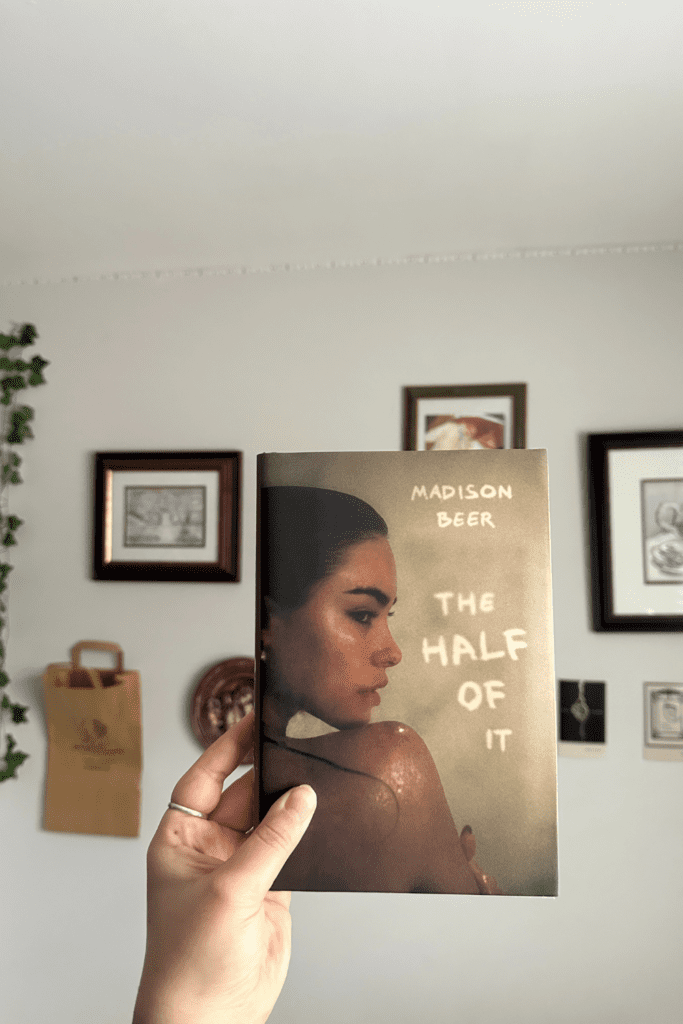
- Date finished: January 22nd, 2026
- Pages: 176
- Format: Hardback
- Form: Non-Fiction
- Language read: English
- Series: Standalone
- Genre: Memoir | Mental Health | Autobiography
Buy “The Half of It”
As I mentioned, “The Half of It” is a memoir by singer-songwriter Madison Beer, depicting her decade in the spotlight. She writes about her music career, mental health struggles, and the online hate and safety violations she’s faced.
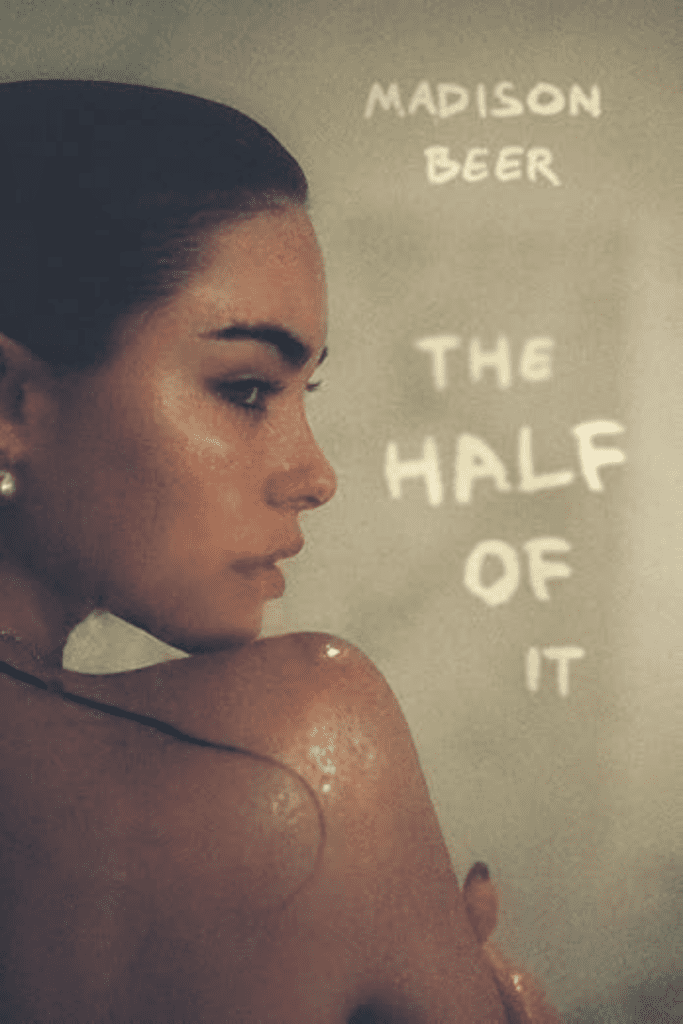
“The Half of It” is a short, vulnerable memoir in which singer-songwriter Madison Beer recounts her journey to becoming a famous pop star, while truthfully depicting the joys, battles, and accumulated trauma she’s experienced along the way. This memoir also contains the occasional Journal Prompts and Responses to her fans’ vulnerable messages about sensitive topics surrounding mental health.
Although she was quite young when she released her memoir (24 years old), at this point, she had already spent half of her life in the limelight. It was around the age of 12 that her YouTube cover was shared by Justin Bieber (back in 2012-2013.)
Being in her twenties now, she grapples with having a different version of an ordinary childhood, as she has worked nonstop since she was 12 and has had her privacy violated multiple times along the way.
I was enraged when I read the passages in which her nudes were distributed all over the internet (‘Twitter’). She was a minor at the time she had sent them to a boy she trusted, and she was still a minor when they circulated at the age of 16. This had deep psychological consequences that she carried for years and had brought her to contemplate suicide and live years in shame spirals.
I was further appalled when I read how this was all handled. Mind you, all of this happened only a decade ago. I was born in 1997 and she was born in 1999, so I recall vividly how vicious Twitter and Instagram were back then. Not that he has changed much but at least as a society we are slowly waking up to the disastrous and exploitive nature of internet leaks, online trolls, etc.
In the aftermath, the hardest part for me to digest was the fact that no one showed up for an underage girl who’d had her privacy violated so ruthlessly. I scoured the internet trying to find one person sticking up for me, just for some sort of comfort-some sort of confirmation that I wasn’t entirely in the wrong. I found nothing. Not one person felt bad that I’d had my trust betrayed.
Not one person reached out and reassured me that it wasn’t my fault. No one stood up and said, “Hey, maybe this reaction is wrong, and she is only human.” It was only wave after wave of shame. (p. 37)
I’ve been a ‘fan’ (I use fan lightly because I don’t subscribe to parasocial relationships) of hers since I was also in my teens and I’ve always remembered how she was constantly overly sexualized by even her own fans and criticised for everything she did (who she dated, how she sang, what she wore, how she looked, etc.)
It is my personal belief that because she was discovered with no direct connections to the industry, it has left millions resentful of her journey, especially since becoming a celebrity online wasn’t as easy and accessible back then (you had to be a famous YouTuber or Vine creator in LA in that 2012-2015 era). Plus, she was naturally very pretty from a young age. This is one of those odd cases where I think pretty privilege had at least half as many drawbacks in a person’s life.
Yet, these are just my speculations after a decade of listening to her music and occasionally tuning into ‘online’ posts and social media gossip.
Nevertheless, I don’t know Madison Beer personally, and I never will. I know her music, and now I’ve read her memoir. And her memoir has made me believe that she’s grown to be a mature, level-headed celebrity who refuses to keep silent on the very real injustices of cyberbullying, the spreading of online hate, industry abuse, and media misogyny:
I didn’t know it at the time, but it’s indicative of a bigger problem. Misogyny is woven so deeply into our society that everyone’s first reaction was to be disgusted by me—by the fact that a young girl would even think of exploring her sexuality. If I was a boy, it would have been different. The reaction would have been, “Oh god, poor kid, he must be so embarrassed.” If I was a boy and it was a girl who leaked the video of me, she would be the one blamed—called psycho, manipulative, and vindictive.
If I was a boy, I would have been shielded from the consequences of my actions and allowed to move on from my mistake.
But I was a girl, and I wasn’t allowed to be sexual, even when all of my friends were doing the same thing behind closed doors.
Yes, I was underage. was young, and that’s what complicates it. But developmental psychology agrees that early adolescence is when we start exploring our sexuality. By those standards, I was progressing age-appropriately by doing something as simple as having curiosity about my own body. Sending the video to a boy wasn’t the best idea, but that’s not what people were mad about.
They were shocked that I—a female—was expressing any sort of sexual autonomy. (pp. 38-39)
The fact that she had to pay to hire someone to take down literal child pornography is so harrowing. The worst of it? No one can be held accountable. We, as a society, industry agents, fans, and users of social media, should come together to make these spaces safer.
No one’s rage was coming from a place of concern. None of the backlash online was to protect me from being exploited, or to educate me about sexual health, consent, or internet safety.
No, I was being shamed for being sexual in general. My peers were making fun of me for trying to be “sexy.” People were joking about something that was so traumatic for me. And it was even more difficult as a young girl with past sexual traumas. I’d already had my bodily autonomy and my trust betrayed, and now here it was again, being broadcast for the world to see.
At the end of the day, I should have been protected. And if I had been, it would have saved me years of damage. Instead, I faced the harsh reality of internalized misogyny and what it means to be female in a world that prioritizes male sexual desire. (p. 39)
In her memoir, Beer raises important questions, and one I’ve been thinking about more and more when it comes to online hate and celebrities’ personal privacy — we’ve normalized abuse for so long because the public does not see celebrities as humans. Heck, just look at how paparazzi behave to this very day. Now add in fake profiles, vapid online forums, and the dark web. It’s a giant mess.
I think a lot of people have misplaced their anger. Musicians do a job. Actors do a job. Yes, the nature of that job allows for greater opportunities, privileges, riches, etc., but I’ve long outgrown the belief that they should be treated any better or worse than the rest of us. Especially in the digital age, where the common person can become famous online overnight.
Whenever someone speaks up about how the hate affects them, the backlash is always something along the lines of “Well, sorry, but you shouldn’t be in this career if you can’t handle it.” But what about “You shouldn’t be on social media if you can’t conduct yourself responsibly?” What about “We need to do a better job of protecting each other online?”
If I let myself view it as normal, I would be accepting treatment I didn’t deserve. It didn’t feel like something I could compromise on. It was wrong. And I wanted to keep fighting against it—I had to be vocal about its effects, even just to maintain my honesty with my fans.
For me, it boiled down to one question: Who am I helping by pretending that it doesn’t affect me? No one.
If anything, pretending to be above the hurt only gives haters a free pass. Either people will think it’s okay to keep being abusive online because it doesn’t hurt me anyway, or they 11 ramp up the hate for the sole reason of seeing how much it takes to actually get through to me.
These are things no one would dare say to my face, because they’d be too afraid. It’s a form of public humiliation. Sometimes I hesitate to use the word cyberbullying because it downplays the severity. If a partner or a family member used the same insults to me that I hear online, it would qualify as verbal abuse. Yet for some reason we don’t take it seriously when it’s over a computer screen. I would never tell my future child, if they’re getting bullied, that they just have to suck it up and get used to it. (p. 114)
Art is our highest form of expression. Creators of large or small projects, whether famous or unknown, deserve the same rights. They shouldn’t be treated above the law or below human decency because of fame, influence, or monetary status.
Unfortunately, that’s not how the world works so long as we cling to the old ways. I am confident, however, that a shift is coming soon.
Fame is fleeting; personality is what matters. Expressing human and artistic visions is more crucial than ever.
Although the aftermath of all of this harm and vitriol caused her severe mental health problems, trust issues, and robbed her of a sense of safety, Madison Beer remained steadfast in her artistic visions. She continued to create, explore her range, and connect with her fans while sharing her struggles and expressing both vulnerability and openness.
Madison Beer’s 2021 debut album Life Support became her life support at the time:
The summer of 2019 was simultaneously the lowest point of my personal life and the height of my creative career. It was a very transitional period—I was newly twenty, working on my album for hours a day, while also falling deeper and deeper into a pit of depression and anxiety. I was becoming more and more dependent on drugs like Xanax to sleep at night, and I was actively suicidal, but I had grown so used to it that the thought didn’t alarm me anymore. I’d wake up, tell myself I’d rather not have, and continue on with my day. I titled my album Life Support because that’s genuinely what it was—my lifeline. If I didn’t have the studio to escape to during the day, I wouldn’t have left my apartment at all.
The issues that began boiling under the surface after I started my career had only gotten worse as I got older. I struggled heavily with self-harming, but I was hurting myself in countless other ways too. I was abusive toward myself and allowed other people in my life to get away with that same behavior, simply because I felt like I deserved it. (p. 59)
I believe this is why, from the start, a lot of teens and girls have related to her music. She depicts love, heartache, betrayal, self-doubt, and depression in such a vulnerable and veritable light. As someone who’s also dealt with self-harm, a cocaine addiction (instead of a Xanax addiction), and a BPD diagnosis, reading Madison Beer’s personal account feels important. It takes a lot of guts and courage to discuss what years of shame and anxiety do to one’s mental health and well-being.
Since the publishing of her memoir in April 2023, Madison Beer continues to write good music, goes on sold-out tours, and expands her talent both in genre and craft. I look forward to a future memoir that is granted the space to focus more on her artistic vision and lessons.
I’m the most openly honest I’ve ever been in the following pages, but that isn’t to say I talk about everything I’ve been through in this book. No matter how much you think you know me, there will always be parts of my story that are for me and me only. That’s kind of the point—you never know everything, even when you think you might. You never know the silent battles people are fighting, even the people you think you’re closest to. You’ll never walk in my shoes, and I’ll never walk in yours. And we shouldn’t have to in order to empathize with each other.
I want my story to represent more than just me. While it’s a story of my life, it’s also a story about the power of empathy and understanding, and what something as simple as human kindness can do in changing someone’s life. If I can do any good by sharing my own personal experiences, I’Il never hesitate to speak up.
With that being said, just because it happened this way, that doesn’t mean it should have.
⭐⭐⭐⭐

Leave a Reply