This post may contain affiliate links, which means I’ll receive a commission if you purchase through my links, at no extra cost to you. Please read my full disclosure for more information.
“Things in Nature Merely Grow” is a gutwrenching, unflichingly honest non-fiction memoir about Yiyun Li’s thoughts on losing her second son, James, to suicide, following the loss of her first son, Vincent, a few years prior.
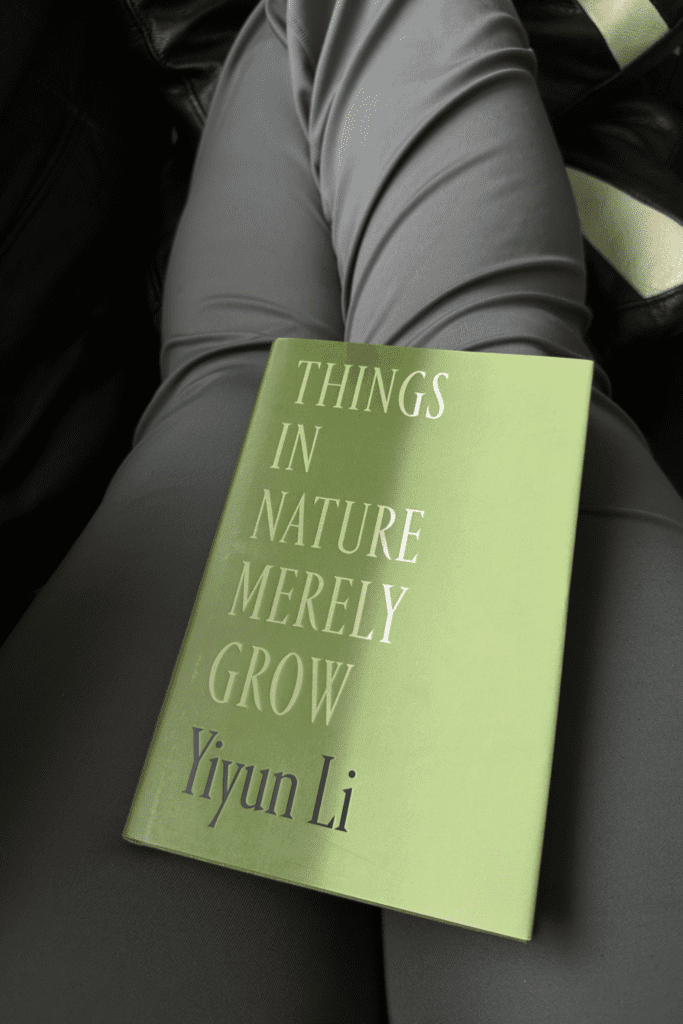
- Date finished: February 3rd, 2026
- Pages: 192
- Format: Hardback
- Form: Non-Fiction
- Language read: English
- Series: Standalone
- Genre: Memoir | Mental Health | Grief
For a summary of “Things in Nature Merely Grow,” I will leave you with Yiyun Li’s own words: “There is no good way to state these facts, which must be acknowledged . . . My husband and I had two children and lost them Vincent in 2017, at sixteen, James in 2024, at nineteen. Both chose suicide, and both died not far from home.”
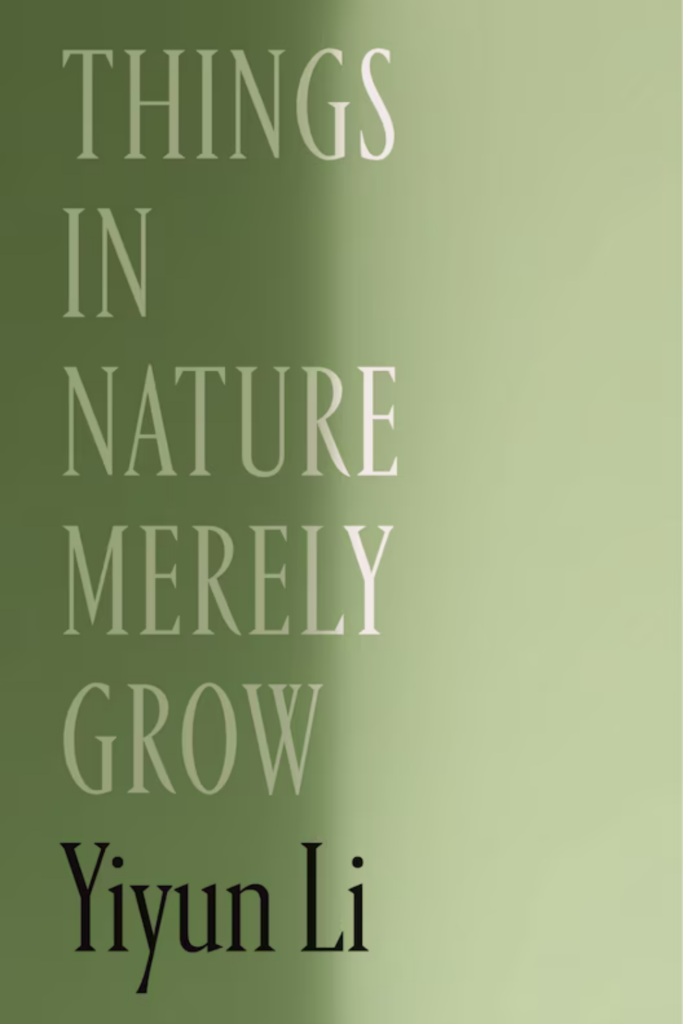
“Things in Nature Merely Grow” is a book that is at once truly devastating and yet filled with so much vigor.
I want to preface this by saying that the subject of grief (forgive me, Yiyun Li, for employing this word) and suicide weigh heavily in this book. I do not recommend reading it in a poor mental state.
I’m glad I’ve got to read this in a good headspace. It has only been three years since I’ve been mentally stable after decades of mental illness and emotional instability. I had been suicidal since I was about 7, and it has taken me 20 years to learn how to want to live and to truly stop harming myself, if that makes any sense. The desire to self-harm doesn’t magically leave one day but it lessens overtime.
But enough about me!
I’m a recent fan of Yiyun Li. I’ve only discovered her works in the last year, and I’m obsessed with her cutting writing style, so much so that I bought all of her works to read and digest. This is the second work by her that I’ve read, the first being “Book of Goose.”
Throughout the book, Yiyun Li superposes the facts of life with the fiction she teaches, illustrating the elusive “life is stranger than fiction” sentiment:
Vincent died on the day we put down the deposit for the house. Deposit, death, in that order, four hours apart.
I would never have put those two things on the same day in a novel. In writing fiction, one avoids coincidences like that, which offer convenient metaphor, shoddy poignancy, and unearned drama. Life, however, does not follow a novelist’s discipline. Fiction, one suspects, is tamer than life. (p. 13)
This distinction between fact versus fiction is quite significant in this book since her son James was more of an analytical thinker than her son Vincent, hence why Yiyun Li continuously cements facts over feelings to honor him:
The truth is that however I choose to express myself will not live up to the weight of these facts: Vincent died, and then James died; through writing, I was able to conjure up a Vincent in the book written for him, but I will not be able to do this for James—I cannot conjure him up in any manner. (p. 18)
In this matter, Yiyun Li gives so much dignity to James — by understanding that she needs a new way, a new language to represent him even though it eludes and challengers her:
It’s an impossible task to write a book for James. It will have to be done through thinking, rather than feeling; that is how I will reach for an approximation of understanding James. Or of not understanding him—just as I might spend my days reading Wittgenstein, not knowing if I’ve got anything right. (p. 20)
So, here’s the fact: I am in an abyss. I did not stray into the abyss. I did not fall into the abyss. I was not bullied or persecuted by others and thrown into the abyss. Rather, inexplicably and stunningly, I simply am in an abyss.
I am not lost. The feeling of being lost—a disorientation akin to despair-occurred briefly after Vincent died. I remember, after dropping off James at school, driving under a leaden sky, thinking that there was nowhere for us to go.
But that thought of having nowhere to go, just as the statement that no one would surprise me after Vincent died, was an expression of hyperbole, which is unavoidable in anguish: feelings, unexamined, present themselves as thoughts; even, facts.
This time I have been careful not to mistake feelings as thoughts or facts. My feelings: stunned, but not lost. My thought: I am found in an abyss. (pp. 22-23)
Another way to honour and respect James is by calling his death for what it is: a suicide and not an accident. Yiyun Li avoids any euphemism, and by doing so she expresses unconditional love while respecting James’s memory and his decision to end his life.
Some people (especially in China) make a fuss about my using the word “die” when I talk about the deaths in my life, equating this linguistic decision to coldhearted-ness or evil.
Indeed there are euphemisms one could use. The word “euphemism,” coming from Greek euphēmismós and meaning the substitution of an auspicious word for an inauspicious one, may imply sensitivity, but it may also imply cowardice. It is the latter, rather than the former, that puts people in the mood to censor and demonize.
Death, particularly suicide, cannot be softened or sugarcoated. After Vincent died, a couple of mothers asked me if they could tell their children—Vincent’s peers—that he had died in an accident. That they preferred to lie to their children, even though the truth would surely reach those children through their friends, baffled me. I explained to the mothers that their proposal seemed to me a disrespect of their own children and a violation of Vincent’s memory. Not calling a fact by its name can be the beginning of cruelty and injustice. (p. 23)
Additionally, Yiyun Li raises great questions around parenting and the way we discuss (or avoid discussing/shunning) suicide. Reading the way she thinks and deeply understands and knows both of her children has healed a little part of me, that heavy part in which my own parents never bothered to understand about me and instead shamed and criticized me for.
What can parents do but give their children the space to be, and allow them to do what they need so they can become more of themselves?
And yet, despite the parents’ efforts, and despite all the beings and doings that occur as the children grow, some among them die before their time.
Children die, and they are not happy.
And their parents can never know if those children died because they were not happy, or they were not happy because they sensed, too early, that they must face their own deaths. (p. 35)
I remember feeling connected and understood in this way when I had read her book “Book of Goose.” I recall thinking this is an author who understands children even after becoming an adult and/or a parent herself. It is rare for me to think that about most people, and I have only found a few instances of these adults in real life, while the rest I’ve found mostly in author memoirs, or as always between the pages of books.
It’s been my experience, both as a child and as a parent, that adults—at least those specializing in arrogance and ignorance, and those who easily forget or else write off their own childhood memories—are extremely good at underestimating children. A ten-year-old already has the capacity to understand life’s bleakness. Only, most ten-year-olds have not found the language to articulate their feelings, and very few of them have the ability to find a way out of that all-encompassing bleakness unaided. (pp. 38-39)
By simply readind what she writes in the following passage: (‘to honor the sensitivity and peculiarity of my children,’) one can only hoefully assume that James and Vincent found comfort and safety in having Yiyun Li as a mother. This is also a monstrously stark contrast to Li’s own upbringing in China by a mother who was controlling, traumatizing, emotionally and physically abusive:
It seemed to me that to honor the sensitivity and peculiarity of my children—so that each could have as much space as possible to grow into his individual self—was the best I could do as a mother. Yes, I loved them, and I still love them, but more important than loving is understanding and respecting my children, which includes, more than anything else, understanding and respecting their choices to end their lives.
(Love does not guarantee understanding or respect. I cannot challenge my mother’s claim that she’s loved me more than she’s loved anyone—more than she’s loved my sister and my father, but perhaps not more than she’s loved herself. “You love your children more than you love me” was a complaint she made when my children were young.
Two years after Vincent died, she informed me that there was some karma in my losing a child: I had failed to return her love for me.) (pp. 46-47)
In this memoir, Yiyun Li writes candidly about her own mental health struggles and previous suicidal thoughts. She therefore understands the reactions of others (‘outsiders’ to these feelings) and the interior of a suicidal person’s mind and intent. At its core, I believe suicide is (but not solely) about ending one’s continuous suffering and hopelessness.
People sometimes say of those who’ve attempted suicide or succeeded that they are selfish, or feebleminded, or attention seeking. People feel hurt, are offended and angry, perhaps out of fear or incomprehension, or perhaps because for once they cannot claim the center of someone else’s story: suicide is among the most absolute and exclusive actions in life. (My mother said to me about my attempt: “Why did you do that to me?”)
Those who’ve attempted suicide or succeeded in suicide are not necessarily eager to kill themselves; rather, the pain can be such that nothing short of wiping out their physical existence can end their suffering. People don’t call those with cancer or other illnesses selfish or feebleminded or attention seeking, but in my experience, people tend to be harsh and critical of those who suffer from suicidal depression or other mental illnesses. Is it a sense of superiority that makes people insensitive, or, more precisely, a deep sense of fear—where you are is where I don’t want to be, so I had better condemn you first to ensure my safety. (pp. 138-139)
Furthermore, not only does Yiyun Li tackle suicide and its famous misconceptions but she also poses something which I will call equal truths, two truths that I’ve accepted a while ago: Yes, life is worth living and Yes, life, for some, is a series of agonizing acts of tolerance (in which suicide becomes an inevitable, almost ideal option.)
Life, in an absolute sense, is worth living, just as art is worth pursuing, science is worth exploring, justice is worth seeking. However, the fact that something is worth doing doesn’t always mean a person is endowed with the capacity to do it, or that a person, once endowed with that capacity, can retain it. The gap between worth doing and being able to do is where aspiration dwells for the young and decline lies in wait for the old.
Is life worth living? Had I asked Vincent, I trust that he would have said yes, but then he would have pressed me with his variations of the question: Is this life, which may be worth living, worth suffering for? If life is worth suffering for, should there be a limit, or should one have to suffer unquestioningly, all in the name of living?
Is life worth living? Had I asked James, he would have declined to answer. I would prefer not to say, he would have replied, in which one could sense the seed of negation. (pp. 140-141)
Just look at the subtle nuances between her two sons in the way that she believed they view life and living:
Vincent lived through his feelings, deep, intense, and overwhelming feelings, and he died from his feelings: a life worth living, in the end, did not prove livable; an acutely artistic and sensitive soul might not always have the means to prevail in this world.
James thought hard: deeply, philosophically, and privately. He died from thinking: a livable life might not be worth the trouble; a livable life, he must have concluded, was not what he wanted. (p. 142)
And the way they experienced their suffering:
Had Vincent lived, had he asked me the question now, I would have answered differently. I know suffering, and I have written well about suffering, but I also know that one’s relationship with one’s suffering can change. For Vincent, I don’t think life would ever have become easier. However, I do believe that we learn to suffer better. We become more discerning in our suffering: there are things that are worth suffering tor, and then there is the rest—minor suffering and inessential pain—that is but pebbles, which can be ignored or kicked aside. We also become less rigid: suffering suffuses one’s being; one no longer resists.
I wish I had shared these thoughts with Vincent when he was younger. It might have helped him a little, or it might not have changed the course of his life or my life. But wishes are but artificial flowers. I did not know back then that one could learn to suffer better. I did not even know it after Vincent’s death. I learned this only after James’s death.
I do not know if these thoughts would have helped James at all. For years, he had perfected suffering as a state of being, and in the end, he too turned away. (pp. 147-148)
These passages were truly revelatory for me. I’ve contemplated suicide in both of these lenses, through the deeply emotive rollercoaster I have been on and through my state of being, simply existing in this world. My previous attempts were purely emotive, but I know that if I ever decided to act on it in the future, it would be with silent grateful acceptance.
You know, while reading this, it cured my so-called writer’s block. I’ve spent many years writing. The act of writing became my release and escape from the terrors of my mind and life. And yet, I’ve found myself in recent years, distracted and unmotivated, taking the lazy way out by labelling ‘writing being too hard’ when really I’ve faced most of my hardest battles: self-harm, addiction, suicide attempts, agoraphobia, horribly enough, the list could keep going (which now makes me laugh).
The following passage, with the context of losing her two sons to suicide, reignited something within me.
Many times this book moved me to tears and made me grateful for still being here, still choosing life, and for still being able to write.
Children die, and parents go on living. Those parents go on living because death, though a hard, hard thing, is not always the hardest thing. Both my children chose a hard thing. We are left with the hardest: to live after their deaths.
Sometimes a young writer or a writing student tells me how hard they find writing is. Writing is so hard, they say, with a whine or else self-glorification in their voice. That always puts me in a suspicious mood. If you complain about writing being hard—I sometimes want to say to them—then you must have understood very little about life.
Writing is hard, but living is harder. Writing is optional. Living, too, is optional, though its demands make writing seem idyllic. (p. 59)
There is no good way to say this. Facts are the harshest and the hardest part of life, and yet facts, unalterable, bring with them some order and logic.
Fiction, I’ve learned from writing it and reading it, tends to be about the inexplicable and the illogical. Sometimes my students complain about what they read in fiction—I don’t believe this would happen in life, or, I don’t believe any parent would do that to their children.
What can I say to a young person who has strong convictions but a failure of the imagination? Not much, really.
The world, it seems to me, 1s governed by strong conviction and paltry imagination and meager understanding. (p. 11)
Words, words, words. Words form castles on the solid ground and in the clouds, words become armors and Prison walls, words make riptides and quicksands. One can never take words for granted; one cannot always trust words; and yet, where else can my mind live but in words? (p. 129)
⭐⭐⭐⭐⭐⭐
Leave a Reply