
This post may contain affiliate links, which means I’ll receive a commission if you purchase through my links, at no extra cost to you. Please read my full disclosure for more information.
“Sunrise on the Reaping” is another prequel to The Hunger Games series. In this book, we follow Haymitch Abernathy as he’s thrusted into the 50th Hunger Games, also known as the second Quarter Quell, which held double the number of contestants. (In the original trilogy, Haymitch is the District 12 grumpy alcoholic mentor of Katniss Everdeen and Peeta Mellark during the 75th Hunger Games.) Now, we get a glance at Haymitch’s tragic backstory – ripped away from his loved one, tasked to both fight and survive while protecting contestants from his District, and destined to fail in the Capitol’s deadly games.
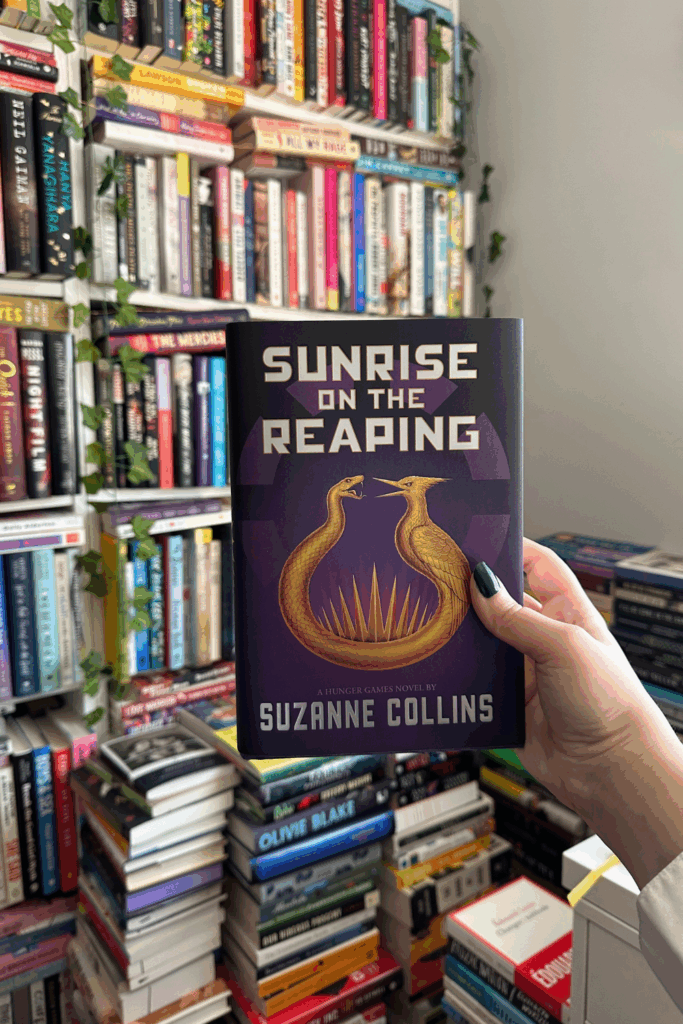
- Date finished: April 6th, 2025
- Pages: 387
- Format: Hardback
- Form: Fiction
- Language read: English
- Series: The Hunger Games
- Genre: Dystopia | Young Adult | Science Fiction
“Sunrise on the Reaping” follows the tragic story of Haymitch Abernathy as he’s thrusted into the 50th Hunger Games, also known as the second Quarter Quell, which held double the number of contestants. Suzanne Collins brings us another dystopian tale of survival, loss, love, and, most importantly, resilience in the face of political manipulation, propaganda, and a totalitarian regime.
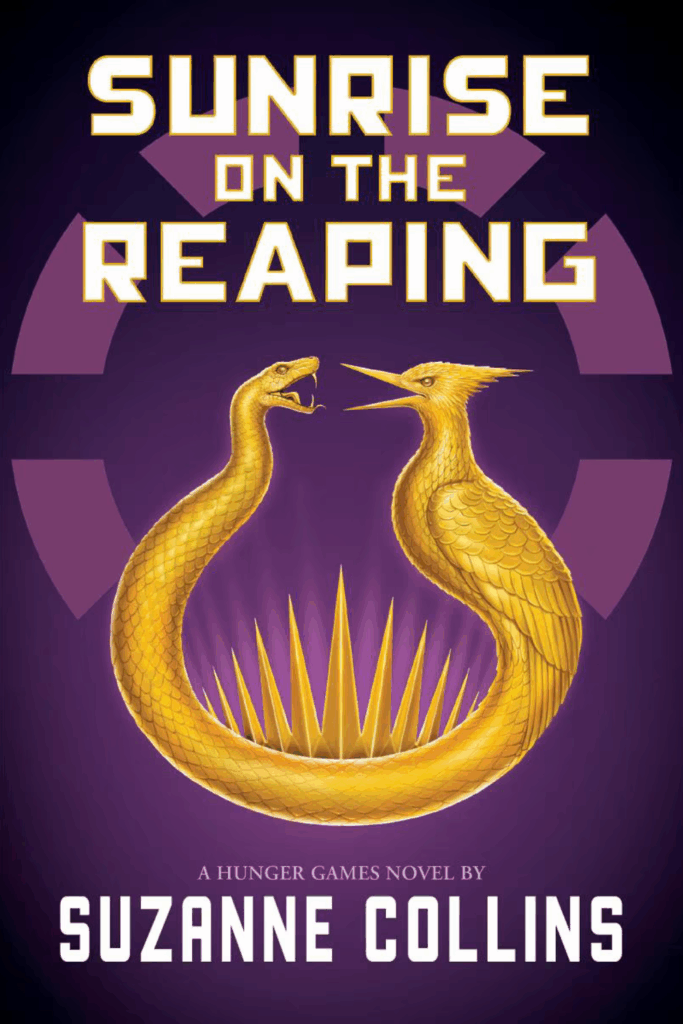
You can always count on Suzanne Collins for two things: 1) her amazing use of symbol and motif, and 2) for her novels to sucker punch you in the gut and make you violently sob by the end of the story. And in unison, we say, “Thank you, Suzanne. When’s the next one, please?”
“Sunrise on the Reaping” is the book that solidifies the Hunger Games as the ultimate propaganda machine for the Capitol. Through Haymitch’s story, we witness the embers waiting for decades for Katniss’s fire to catch. Suzanne Collins could not be any clearer with her epigraphs (which is very apt for our era of mass misinformation and AI-generated slop):
“All propaganda is lies, even when one is telling the truth. I don’t think this matters so long as one knows what one is doing, and why.”
— George Orwell
“A truth that’s told with bad intent
Beats all the lies you can invent.”
— William Blake
Suzanne’s clever use of family legacy, personal agency, and self-fulfilling prophecy is what makes the ending and the beginning of the character we are introduced to as Haymitch Albernathy incredibly heartbreaking.
I have to agree and, though I’m not a drinker myself, I’m glad to get the bottle. I can easily sell it or trade it or possibly pass it on to Lenore Dove’s uncle, Clerk Carmine, so that he might have a kinder opinion of me. You’d think the son of a washerwoman would be harmless enough, but we Abernathys were known rebels back in the day, and apparently we still carry the scent of sedition, scary and seductive in equal parts. Rumors spread after my father’s death, rumors that the fire had not been an accident. Some say he died sabotaging the mine, others that his crew was targeted by the Capitol bosses for being a pack of troublemakers. So it could be my kin’s the problem. Not that Clerk Carmine has any love for the Peacekeepers, but he’s not one for yanking their chain either. Or maybe he just doesn’t like his niece running around with a bootlegger, even if the work’s steady. Well, whatever the reason, he rarely gives me more than a terse nod, and he once told Lenore Dove that I was the kind that died young, which I don’t think he meant as a recommendation. (p. 5)
This book also ties well with Coriolanus Snow’s personal vendetta against Lucy Gray Baird since Lenore Dove is her relative, whereas Katniss Everdeen is a distant relative of Lucy Gray. And hence the haunting tones of the Covey song that will never be erased by these women’s shared history. Rebellion, like music, trickles fiercely down their entire bloodline!
“I’m Haymitch.”
“I’m Lenore Dove.”
“Dove like the bird?”
“No. Dove like the color.”
“What color’s that?”
“Same as the bird.”
That started my head spinning and I guess it’s never quite stopped. Soon after at school, she waved me over to a dog-eared dictionary and pointed. Dove color: Warm gray with a slight purplish or pinkish tint. Her color. Her bird. Her name.
After that, I started to notice things about her. How her faded overalls and shirts concealed snips of color, a bright blue handkerchief peeking from her pocket, a raspberry ribbon stitched inside her cuff. How she finished up her lessons quick, but didn’t make a fuss about it, just stared out the window. Then I spotted her fingers moving, pressing down imaginary keys. Playing songs. Her foot slipped from her shoe, her stockinged heel keeping time, silent against the wood floor. Like all the Covey, music in her blood. But not like them, too. Less interested in pretty melodies, more in dangerous words. The kind that lead to rebel acts. The kind that got her arrested twice. She was only twelve then, and they let her go. Now it would be different. (pp. 7-8)
We can see this vedetta highlighted in Snow’s warning to Haymitch:
“Dove,” I tell him.
“Dove!” He smacks his forehead. “Dove. I have always heard ‘dove color,’ though. It’s a bit of a cheat. But who could resist when you get both the color and the bird? And we know how they feel about their birds.”
He returns the striker. On the back, in minuscule script, are the words I’d missed. For H. I love you like all-fire. L.D.
“Do you know much about doves, Haymitch?”
“They’re peaceful.”
“If they are, they’re outliers. All the birds I’ve encountered are vicious.” A dribble of bloody spittle leaks from Snow’s mouth.
“Bet I know a thing or two about your dove.”
“Like what?”
“Like she’s delightful to look at, swishes around in bright colors, and sings like a mockingjay. You love her. And oh, how she seems to love you. Except sometimes you wonder, because her plans don’t include you at all.”
Not exactly, but too close. I think of the misty look she gets when she talks about the open road, the life of the Covey, and a kind of freedom that has nothing to do with me. Worse, I think of Clay Chance and the fire under the reaping stage and how there’s a part of her she refuses to share with me. She’d say it was to keep me safe, but maybe she just doesn’t trust me with her secrets.
“She loves me,” I insist.
“No doubt she says so. But believe me, romantically speaking, you’re dodging a bullet with these Games.” (p. 129)
Another aspect I loved about this book is Haymitch’s character development. When we first meet him, we understand that his priority is to protect and provide for those he loves. Once he’s reaped, however, he becomes an active agent to take down the games and do right by District 12.
I guess we’re going to talk about it. “I’s going to be all right,” I say, which rings hollow.
“You don’t really believe that, do you?”
“Maybe not. But I try to. Because the reaping’s going to happen no matter what I believe. Sure as the sun will rise tomorrow.”
Lenore Dove frowns. “Well, there’s no proof that will happen. You can’t count on things happening tomorrow just because they happened in the past. It’s faulty logic.”
“Is it?” I say. “Because it’s kind of how people plan out their lives.”
“And that’s part of our trouble. Thinking things are inevitable. Not believing change is possible.”
“I guess. But I can’t really imagine the sun not rising tomorrow.”
A crease forms between her eyebrows as she puzzles out a response. “Can you imagine it rising on a world without a reaping?”
“Not on my birthday. I’ve never had one that came without a reaping.”
I try to distract her with a kiss, but she’s determined to make me see. “No, listen,” she says earnestly. “Think about it. You’re saying, ‘Today is my birthday, and there’s a reaping. Last year on my birthday, there was also a reaping. So every year, there will be a reaping on my birthday.’ But you have no way of knowing that. I mean, the reaping didn’t even exist until fifty years ago. Give me one good reason why it should keep happening just because it’s your birthday.”
For a girl who’s quiet in public, she sure can talk up a storm in private. Sometimes, she’s hard to keep up with. Lenore Dove is always patient when she explains stuff, not superior, but maybe she’s just too smart for me. Because while it’s a fine idea, thinking about a world with no reaping, I don’t really see it happening. The Capitol has all the power and that’s that. (pp. 10-11)
There is a stark contrast between the previous passage and the following one. We get the taste of an incremental character development before Haymitch even enters the arena (incidentally, this is also his tragic coming of age story; although the contestants are children, those who survive return severely severed from their already less than ideal childhood):
“I want all that, too. What you just said. But if I could, I’d also like to …” I glance at the camera in the corner. How do I say it when the Capitol might be watching? That I want to make the Capitol own what they’re doing to us? “I want to remind people I’m here because the Capitol won the war and thinks that, fifty years later, this is a fair way to punish the districts. But I’d like them to consider that fifty years is enough.”
That sounded sufficiently diplomatic. I wait for them to laugh or roll their eyes, but no one does.
“So you want to make them end the Hunger Games for good. How?” asks Maysilee.
“I don’t know yet,” I admit. “I guess, for starters, by reminding the audience that we’re human beings. The way they talk about us… piglets… beasts. They called my fingernails claws. You saw how those kids outside the gym looked at us. Like they think of us as animals. And they think of themselves as superior. So it’s okay to kill us. But the people in the Capitol aren’t better than us. Or smarter.” (p. 96)
Another plot element that I love, which Collins is brilliant at, is the use of famous names in literary history. In this case, it is Lenore Dove from Poe’s poem “The Raven.” A soulful poem symbolizing lost love and centering a drunken madman (Poe, the writer.) From the very beginning, we know that Lenore will be no more and that Haymitch will sink into the oblivion of a bottle and be haunted by his deceased paramour, Lenore Dove. [As an aside, Collins did this as well with Coriolanus, a legendary but vegenful Roman general popularized by Shakespeare’s play Coriolanus.]
Then I spy a name I recognize, even though I’ve never seen the stuff. I lift the bottle and let the light dance off its rosy depths.
“It’s called nepenthe,” says Plutarch. “You probably haven’t heard of it.”
You’d be wrong there, Plutarch. Not only have I heard of it, I know it from the poem that gave my love her name. I’m tired of being patronized, so I decide to put him in his place. “You mean, like ‘Quaff, oh quaff this kind nepenthe …’?”
Plutarch’s eyebrows shoot up in surprise. He completes the line. “’… and forget this lost Lenore!’”
Now I’m surprised, and a little unsettled. I guess, with all these books, her poem could be here. But for him not only to have read it, but memorized it, unnerves me. I don’t like her name in his mouth.
“Of course, it’s unclear in the poem if nepenthe’s the liquor or the drug added to the liquor,” he continues.
I remember having this same discussion with Lenore Dove. She said quaff means to drink, usually something with alcohol. And the guy telling the story in the song is trying to stop thinking about how he lost his true love.
“I think the important part is it makes you forget terrible things,” I say. (p. 122)
And finally, the most heartbreaking element: the continuous motif of sunrise on the reaping, which in itself becomes the refrain for Lenore Dove’s rebellious acts and in the end her absence. We’re meant to understand this as a token for everlasting hope and resistance until the eventual abolition of the Hunger Games.
In this book, we’ve come to know, through Haymitch’s story, the districts’ sacrifices in preventing another sunrise on the reaping.
I hit the bottle even harder. Drinking, disappearing into the night, regaining consciousness in the forgotten places of District 12. One morning, at the crack of dawn, I snap awake, shivering, in a back alley in town. I’m staring at a message sprayed in bright orange paint. NO CAPITOL, NO HANGING TREE!
It’s a rebel play on the Capitol’s propaganda. NO CAPITOL, NO REAPING! Tucked away in this alley, a rallying cry beyond the Peacekeepers’ radar.
A memory tugs at me… Maysilee in the arena… after she killed the Gamemaker… spider silk and her mamaw’s song…
“Well, your gal’s full of surprises. Guess she got the jump on us after all.”
Full of surprises. Full of secrets, even from me. But Maysilee had put it together. Orange paint on her fingernails. This is Lenore Dove’s work. Her sign. Her message to me now. Her reminder that I must prevent another sunrise on the reaping.
And it says, “You promised me.”
With that, she condemns me to life. (p. 373)
That’s when I see Lenore Dove. She’s up on a ridge, her red dress plastered to her body, one hand clutching the bag of gumdrops. As the train passes, she tilts her head back and wails her loss and rage into the wind. And even though it guts me, even though I smash my fists into the glass until they bruise, I’m grateful for her final gift. That she’s denied Plutarch the chance to broadcast our farewell.
The moment our hearts shattered? It belongs to us. (p. 35)
I know one thing, though: The Capitol can never take Lenore Dove from me again. They never really did in the first place.
Nothing you can take from me was ever worth keeping, and she is the most precious thing I’ve ever known.
When I tell her that, she always says, “I love you like all-fire.”
And I reply, “I love you like all-fire, too.” (p. 382)
⭐⭐⭐⭐⭐






Leave a Reply