
This post may contain affiliate links, which means I’ll receive a commission if you purchase through my links, at no extra cost to you. Please read my full disclosure for more information.
“A Study in Drowning” follows Effy Sayre and her nemesis Preston Héloury, as they are tasked to redesign Hiraeth Manor, the family house of the deceased but highly beloved author Emrys Myrddin.
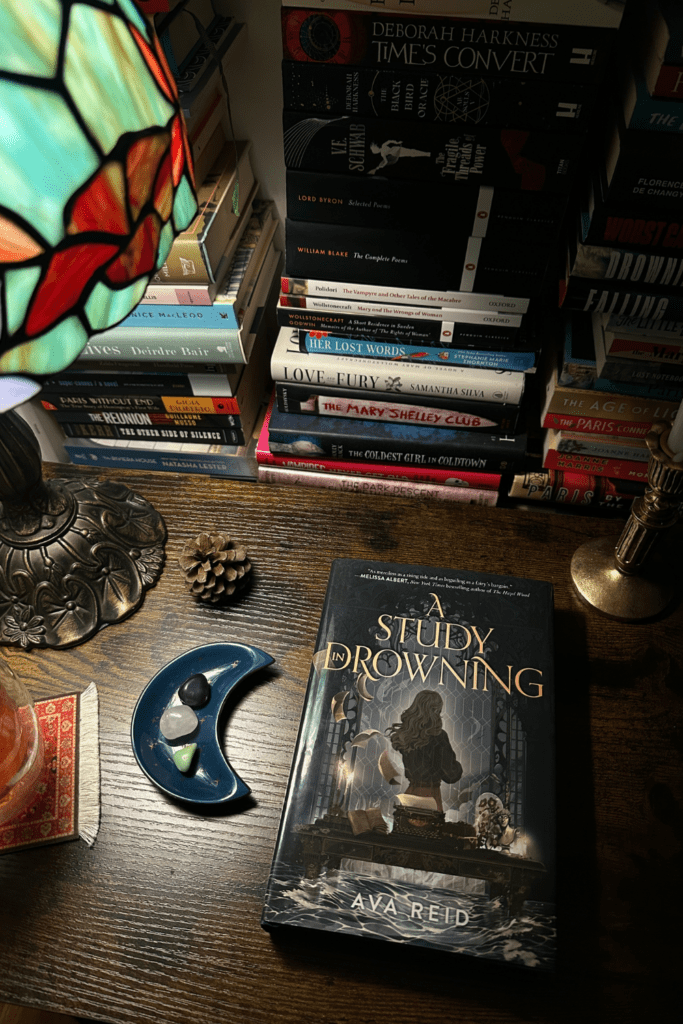
- Date finished: April 6th, 2024
- Pages: 387
- Format: Hardback
- Form: Fiction
- Language read: English
- Series: A Study in Drowning
- Genre: Fantasy | Dark Academia | Young Adult
“A Study in Drowning” is a story about stories, survival, and love. Effy, who’s always believed in the stories of the Fairy King, venerates this author for his fable called Angharad in which he writes about a mortal girl who falls in love with the Fairy King before destroying him. But in this tale, all is not as it seems, and the stakes run high as the manor is literally collapsing into the sea.
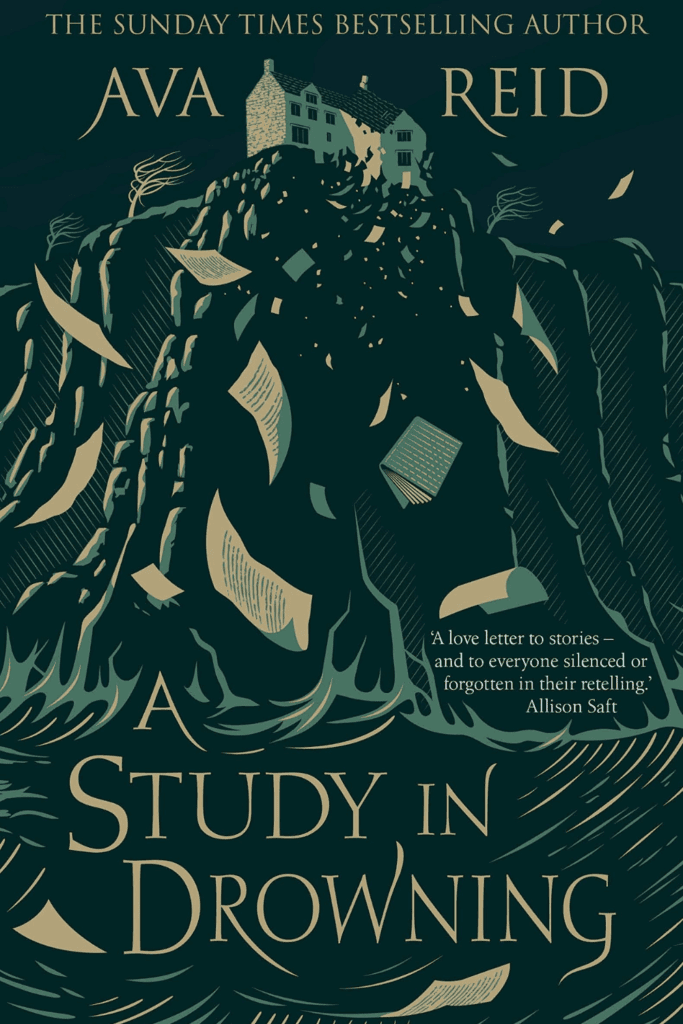
In “A Study in Drowning,” Ava Reid presents a narrative that illustrates both the healing and destructive power of believing in myths and fairytales.
From the start, we understand that the war between Lyrian and Argant is fuelled by the stories that have been instilled into the fabric of the warring countries’ ethos:
Just faintly, through the ever-present rheum of fog, Effy could glimpse the other side of the lake, and the green land that lay there.
Argant, Llyr’s belligerent northern neighbor. She used to think the problem was that Argantians and Llyrians were too intractably different, and that was why they couldn’t stop going to war and hating each other. Now, after living in the divided city for six weeks, she understood that it was the opposite problem. Argant was always claiming that Llyrian treasures and traditions were really their own. Llyr was forever accusing Argant of stealing their heroes and histories. The appointment of national authors, who would eventually become Sleepers, was a Llyrian effort to create something Argant couldn’t take.
It was an archaic tradition, but dutifully followed, even if most Northerners didn’t believe what Southern superstition said: that when Llyr’s tanks rolled across that green land, when their rifles peeked up from the trenches they had dug into Argantian soil, it was the magic of the Sleepers that protected them. That when Argantian guns jammed or an out-of-season fog crept across the battlefield, that was Sleeper magic, too. (pp. 13-14)
And it is precisely fear that enables this hate-fuelled war, as our main character Effy reminds the readers that
“Fear could make a believer of anybody.” (p. 101)
This is further exacerbated in Effy’s case as she has been abused and traumatized — psychological events that shatter her reality and sense of truth (which also typically happens to those who suffer from mental illness and PTSD). We learn that she’s a girl who has been visited and haunted by the Fairy King in her moments of weakness, and is not believed by anyone (her doctors, mother, and even Preston at first).
Effy hated that she couldn’t tell right from wrong, safe from unsafe. Her fear had transfigured the entire world. Looking at anything was like trying to glimpse a reflection in a broken minor all of it warped and shattered and strange.
Preston had said all he cared about was the truth. Who better, then, to tell her whether her fear was justified? She felt, somehow, that he could be trusted with this.
All that time in the car and he had never touched her. In fact, he had moved about her, around her, in a very careful sort of way, as if she were something fragile he did not want to risk breaking. (p. 105)
I also wanted to note that “A Study in Drowning” presents one of the most beautiful and believable romances I’ve read in a while. Preston is a kind, guiding, and reliable presence throughout. He doesn’t dictate any of Effy’s healing or freedom to investigate the truth in Emrys Myrddin’s authorship and connection to the Fairy King. Instead, he presents a different lens to her — albeit one that is logical and grounded in truth-seeking, one that is also complementary.
He hadn’t spelled it out precisely, but Effy knew what he meant: that truth and magic were two different things, irreconcilable. It was precisely what Effy had been told all her life—by the physicians who had treated her, by the mother who had despaired of her, by the schoolteachers and priests and professors who had never, ever believed her.
Effy had put her faith in magic. Preston held nothing more sacred than truth. Theirs was not a natural alliance.
And yet she found herself unable to refuse. (p. 116)
Once again, Ava Reid depicts the complicated nature of survival and how survivors can become a shell of their former selves, as they believe that survival is the only thing left. I found it particularly touching as a survivor myself. I can relate to where Effy is in her journey and where she’s stuck herself. Thankfully, Preston’s support, combined with her search for the authorial truth, become the catalyst that helps her to redevelop her personal agency and a more optimistic outlook on her life. However, we know that these things take time (as we’ll see in Book 2).
“You don’t understand,” she said. “You weren’t there in that car with lanto. When I jumped out I wasn’t doing it to be reckless—I was saving myself. What you think of as recklessness, I think of as survival. Sometimes it’s not very pretty. Skinned knees and a bloody nose and whatever else. You told me I don’t see myself clearly, but I do. I know what I am. I know that, deep down, there’s not much else to me but surviving, Everything I think, everything I do, everything I am—it’s just one escape act after another.
Believing Myrddin’s stories had become an escape act, too, her greatest and most enduring one. But it had made her unstable, untrustworthy, a fragile, flighty thing. That was the cruelest irony: the more you did to save yourself, the less you became a person worth saving. (p. 276)
Furthermore, it is by helping Angharad that Effy has successfully helped herself and gained justice. Lyr’s most venerated poet, Emyrs Myrddin, represents a world built on lies, where weak men triumph by silencing and controlling women through the means of authorship of their bodies and their words. It is thanks to the work she has done with Preston that her name is jointly plastered with his in their academic paper, her abuser is fired from the university, and she became the first female student to enter Lyrian’s Literature department.
“The Fairy King was all of them,” said Angharad. “Every wanting man has that same wound he can use to slip in. It wasn’t until we were back in the Bottom Hundred, in Hiraeth, that the Fairy King’s hold over Emrys became unshakable. His power was at its peak here. Still, there were years of wondering would the man entering the threshold be my husband, imperfect as he was, or would he be the Fairy King, cruel down to his marrow? It was almost easier when the Fairy King took him over entirely. Then I knew to expect his viciousness, and I had my little mortal tricks.”
“The mountain ash, the rowan berries, the horseshoe over the door,” Effy recounted, realization dawning on her. “All of that wasn’t to keep the Fairy King away. It was to keep him trapped here.” (p. 350)
Another fascinating component to this novel, which added to its lyrical writing style, is the imagery of water/drowning. As we know, drowning is a way of washing away ‘eroding’ the truth, a kind of censorship in its intention. It is also poignant with Effy’s depression that threatens to take over as the manor is burgeoning towards total collapse into the sea. And yet, water represents life, hope, renewal, and most importantly love:
Water finds its way through the smallest spaces and the narrowest cracks. Where the bone meets sinew, where the skin is split.
It is treacherous and loving. You can die as easily of thirst as you can of drowning.
FROM ANGHARAD BY EMRYS MYRDDIN, 191 AD (p. 281)
As I said, we also learn about the enduring power of the sea and how it envelops fear, showing that the academic pair is ready to embark on the treacherous path ahead because where there is fear, there is also love and strength.
“The only reason anything matters is because it ends,” he says.
“I wouldn’t hold you so tightly now if I thought we could be here forever.”
“That makes me want to cry.” She wished he hadn’t said it.
“I know. It’s not the most original argument, and I’m hardly the first scholar to make it—that the ephemerality of things is what gives them meaning. That things are only beautiful because they don’t last. Full moons, flowers in bloom, you. But if any of that is evidence, I think it must be true.”
“Some things are constant,” Effy said. “They must be. I think that’s why so many poets write about the sea.”
“Maybe the idea of constancy is what’s actually terrifying. Fear of the sea is fear of the eternal—because how can you win against something so enduring. So vast and so deep. Hm. You could write a paper arguing that, at least in the context of Myrddin’s works. Well, it might have to be an entire thesis.”
“Oh, stop it. You’re being so relentlessly you.”
She felt his laugh against her back, making them both tremble.
“Sorry. I’ll be quiet now. I’m so tired.”
“Me too.” Effy yawned. “But please go back to being you when I wake up. Don’t go anywhere.”
“You don’t have to worry about that.”
As inevitably as the sea rose up against the cliffs, sleep washed over them both. (pp. 302-303)
I absolutely loved “A Study in Drowning”. It is a book that has stuck with me throughout 2024 and one that I have revisited since. If you enjoyed this review, you can read my review of the sequel, “A Theory of Dreaming,” in the next post here.
You can also watch my A Study in Drowning reading vlog here.
But stories were devious things, things with agendas. They could cheat and steal and lie to your face. They could crumble away under your feet. (pp. 316-317)
The truth was very costly at times. How terrible, to navigate the world without a story to comfort you. (p. 375)
⭐⭐⭐⭐⭐


[…] I had written about Effy’s gradual journey out of survival mode. (You can read that review here.) In this sequel, we continue to watch her grapple with her depression and […]