This post may contain affiliate links, which means I’ll receive a commission if you purchase through my links, at no extra cost to you. Please read my full disclosure for more information.
“Sea of Tranquility” is a time travel novel about art, love, humanity, and the plague. We follow multiple journeys: the exiled Edwin St. Andrew, who travels to Vancouver Island in 1912, Mirella Kessler, who in a pre-pandemic 2020 is in search for her long lost friend Vincent Alkaitis, Olive Llewellyn, a famous postapocalyptic author who is on Earth’s last book tour in 2023, and finally Gaspery-Jacques Roberts, who works as a hotel detective on a Moon colony in 2401.
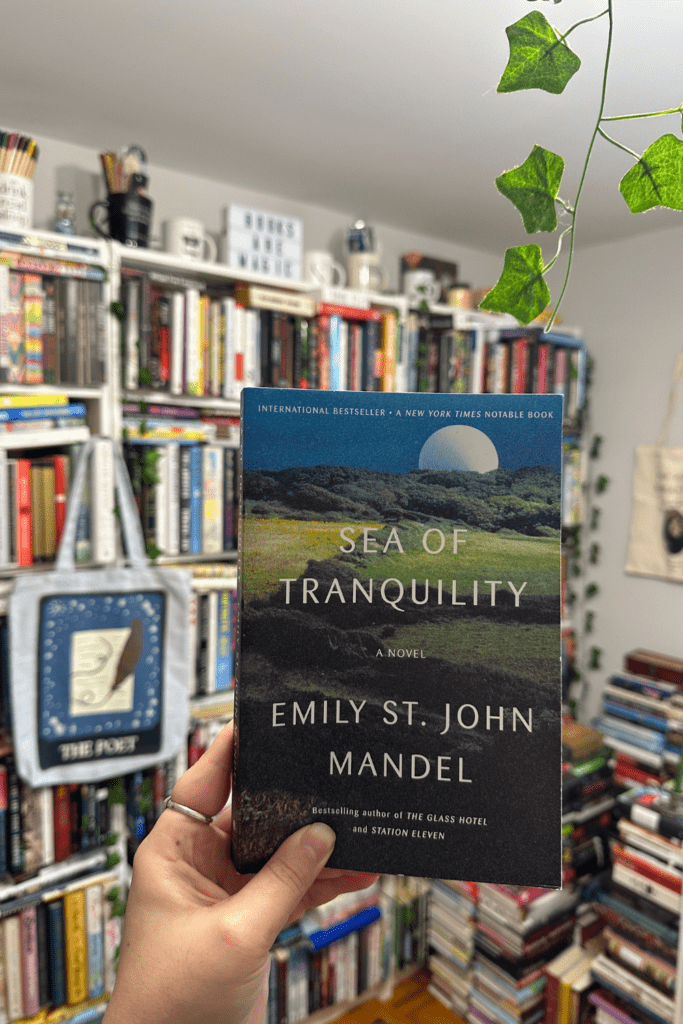
- Date finished: January 9th, 2026
- Pages: 255
- Format: Paperback
- Form: Fiction
- Language read: English
- Series: Standalone
- Genre: Science Fiction | Time Travel | Speculative Fiction
“Sea of Tranquility” is a multi-journey novel following: the exiled Edwin St. Andrew, who travels to Vancouver Island in 1912, Mirella Kessler, who in a pre-pandemic 2020 is in search for her long lost friend Vincent Alkaitis, Olive Llewellyn, a famous postapocalyptic author who is on Earth’s last book tour in 2023, and finally Gaspery-Jacques Roberts, who works as a hotel detective on a Moon colony in 2401.
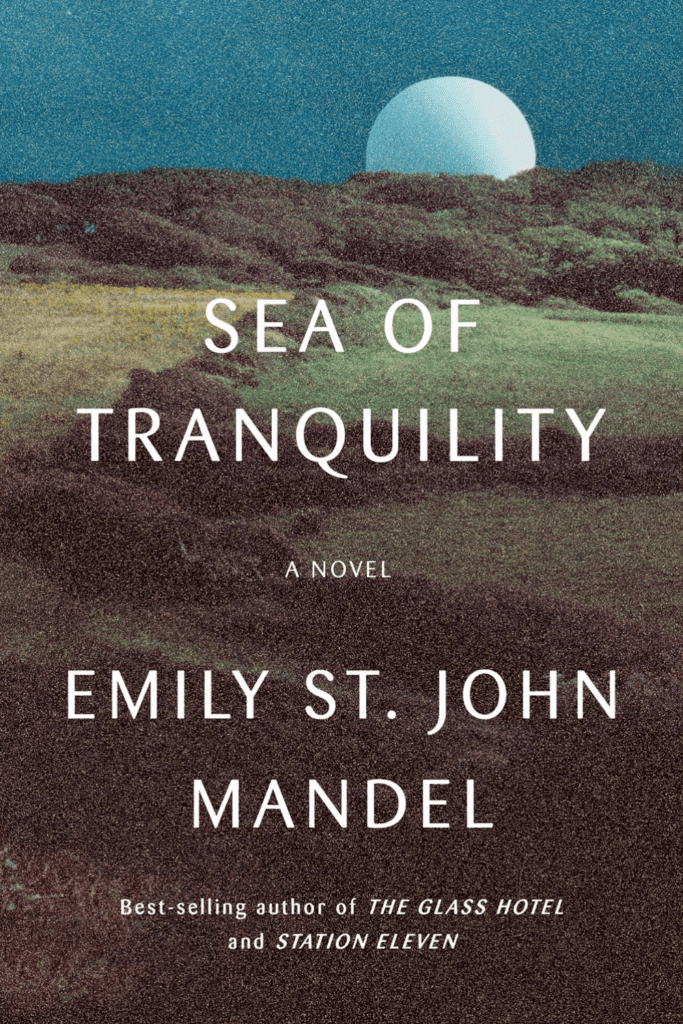
From the very first few pages, I knew I’d love “Sea of Tranquility.” Reading this felt like walking through a lush underbrush. The world that Mandel created is innovative and rich in imagery. Here’s an example, a description of the moon colony of the year 2203:
The first moon colony was built on the silent flatlands of the Sea of Tranquility, near where the Apollo 11 astronauts had landed in a long-ago century. Their flag was still there, in the distance, a fragile little statue on the windless surface. (p. 106)
Mandel has a great talent for building up her stories. She places all of these little bricks that will amount to a grand story where every person, event, and feeling becomes cosmically interlinked.
I did see it. A person in a forest in the twenty-first century sees a flash of darkness and hears noises from an airship terminal two centuries later. A person in an airship terminal in the twenty-third century sees a flash of darkness and is struck by the overwhelming sensation that he’s standing in a forest. (p. 124)
I especially enjoyed following Gaspery’s story, as he’s the heart of it, and through his curious eyes, we learn about the Time Institute. The innovative use of an institution that deals with time travel reminded me of The Ministry of Time, which I’ve read and loved earlier last year (early 2025).
“Can you explain it to me?” It was like being on the outside of a secret club, nose pressed to the glass.
“The simulation hypothesis? Yeah.” She didn’t open her eyes. “Think of how holograms and virtual reality have evolved, even just in the past few years. If we can run fairly convincing simulations of reality now, think of what those simulations will be like in a century or two. The idea with the simulation hypothesis is, we can’t rule out the possibility that all of reality is a simulation.”
I’d been awake for two days and felt like I was dreaming. “Okay, but if we’re living in a computer,” I said, “whose computer is it?”
“Who knows? Humans, a few hundred years into the future? An alien intelligence? It’s not a mainstream theory, but it comes up every so often at the Time Institute.” She opened her eyes. “Oh god, pretend I didn’t say that. I’m tired. I shouldn’t have.”
“Pretend you didn’t say what?”
“The Time Institute part.” (p. 111)
This book grapples with existentialism that is intensified by the idea that life is a simulation. This dread is made even more palpable by the presence of a pandemic that wipes out a great chunk of Earth’s population. Much like Mandel’s previous book Station Eleven, which many read during the COVID-19 pandemic, this novel still hits close to home.
“If moments from different centuries are bleeding into one another, then, well, one way you could think of those moments, Gaspery, is to think of them as corrupted files.”
“How is a moment the same as a file?”
She was very still. “Just imagine that they are.”
I tried. A series of corrupted files; a series of corrupted moments; a series of discrete things bleeding into one another when they shouldn’t. (p. 128)
If we were living in a simulation, how would we know it was a simulation? I took the trolley home from the university at three in the morning. In the warm light of the moving car, I closed my eyes and marvelled at the detail. The gentle vibration of the trolley on its cushion of air. The sounds—the barely perceptible whisper of movement, the soft conversations here and there in the car, the tinny notes of a game escaping from a device somewhere. We are living in a simulation, I told myself, testing the idea, but it still seemed improbable to me, because I could smell the bouquet of yellow roses that the woman sitting beside me held carefully in both hands. We are living in a simulation, but I’m hungry and am I supposed to believe that that’s a simulation too? (p. 129)
How do you investigate reality? My hunger is a simulation, I told myself, but I wanted a cheeseburger. Cheeseburgers are a simulation. Beef is a simulation. (Actually, that was literally true.
Killing an animal for food would get you arrested both on Earth and in the colonies.) I opened my eyes and thought, The roses are a simulation. The scent of roses is a simulation.
“What would an investigation look like?” I’d asked her.
“I think you’d want to visit all those points in time,” Zoey said. “You’d want to speak with the letter writer in 1912, the video artist in 2019 or 2020, and the novelist in 2203.” (p. 130)
While Station Eleven presents a total wipeout of civilization and technology, “Sea of Tranquility” presents the very real anxiety of a mega-advanced, artificially-induced tech world on the Moon, where Time Institute agents can collect data in time to alter and fit their agenda.
“I mean that there are fewer loops than one might reasonably expect. I mean that sometimes we change the time line and then the time line seems to repair itself, in a way that doesn’t make sense to me. The course of history should be irrevocably altered every single time we travel back in the time line, but, well, it isn’t. Sometimes events seemingly change to accommodate the time traveller’s interference, so that a generation later it’s as if the traveller were never there.”
“None of which is proof of a simulation,” Zoey said quickly.
“Right. For obvious reasons,” Ephrem said, “it’s difficult to confirm.”
“But you could move a step closer to confirmation by identifying a glitch in the simulation,” I said. (p. 145)
Thankfully, not all is lost, as Gaspery is the anomaly reminding us that humanity must prevail over any technology or simulation. He reminds us that lives both big and small are worth saving and sacrificing for.
This, I found myself thinking in the years that followed, on nights when my wife and I played the violin together, when we cooked together, when we walked in our fields watching the movements of the farm robots, when we sat on the porch watching the airships rise up like fireflies on the horizon over Oklahoma City, this is what the Time Institute never understood: if definitive proof emerges that we’re living in a simulation, the correct response to that news will be So what. A life lived in a simulation is still a life. (p. 246)
I found the ending incredibly satisfying. Time travel and time loop novels are really hard to wrap up without any major inconsistencies or any magical or scientific hangups, but “Sea of Tranquility” managed it brilliantly.
A countdown had begun. I sensed it in the background of all my days. Sometime soon, I knew, I would move to Oklahoma City. I was scheduled to begin playing the violin in the airship terminal by 2195. I knew, because I remembered the interview, that my wife was going to die first. (p. 247)
I was in pleasant disbelief when I learned that Aretta the publicist is another time-traveller and that Gaspery is the anomaly who becomes the violinist at the airship terminal.
What someone—anyone!—at the Time Institute really should have caught, given how intelligent everyone was supposed to be over there, was that I was the anomaly. No, that’s not fair. I triggered the anomaly. How did no one catch that I was interviewing myself? Because thanks to the documentation Zoey had created, on paper my name was Alan Sami and I’d been born and spent my life on a farm outside of Oklahoma City. (p. 250)
All in all, this book was deeply imaginative, insightful, and full of heart. And the ending presents a message for us readers in the 2020s: to not take life for granted, to not rush to a finish line, to not spend our days scrolling our lives away, to not turn away at injustice, to not let tech companies overrule us.
When I wasn’t playing my violin in the airship terminal I liked to walk my dog in the streets between the towers. In those streets everyone moved faster than me, but what they didn’t know was that I had already moved too fast, too far, and wished to travel no further. I’ve been thinking a great deal about time and motion lately, about being a still point in the ceaseless rush. (p. 255)
A quick final note I want to touch on is that as a writer myself, I quite enjoyed the meta quality of having a postapocalyptic fiction author, represented in Olive Llewellyn, whom I believe can be read as a stand-in for Emily St. John Mandel, since she wrote and published one of the most famous postapocalyptic novels (Station Eleven in 2014) before COVID-19 swept our world in 2020:
“When we consider the question of why now,” Olive said, before a different audience of holograms the following evening, “I mean why there’s been this increased interest in postapocalyptic fiction over the past decade, I think we have to consider what’s changed in the world in that timeframe, and that line of thinking leads me inevitably to our technology.” A hologram in the front row was shimmering oddly, which meant the attendee had an unstable connection. “My personal belief is that we turn to postapocalyptic fiction not because we’re drawn to disaster, per se, but because we’re drawn to what we imagine might come next. We long secretly for a world with less technology in it.” (pp. 190-191)
She argues the very real reality that humans always believe it to be the end of the world (referenced in the ‘Quotes’ section below), and in some ways it is, as we always enter a transformed world after such a catastrophe. But in this case, she presents a chord that strikes us the most: the desire for a world where technology isn’t overshadowing our every move, sentiment, and existence. In a way, “Sea of Tranquility” is more akin to our experiences than Station Eleven was.
No star burns forever. You can say “It’s the end of the world” and mean it, but what gets lost in that kind of careless usage is that the world will eventually literally end. Not “civilization,” whatever that is, but the actual planet. (p. 103)
She paused for effect. Before her, the holographic audience was almost perfectly still. “Because we might reasonably think of the end of the world,” Olive said, “as a continuous and never-ending process.” (p. 190)
⭐⭐⭐⭐⭐⭐

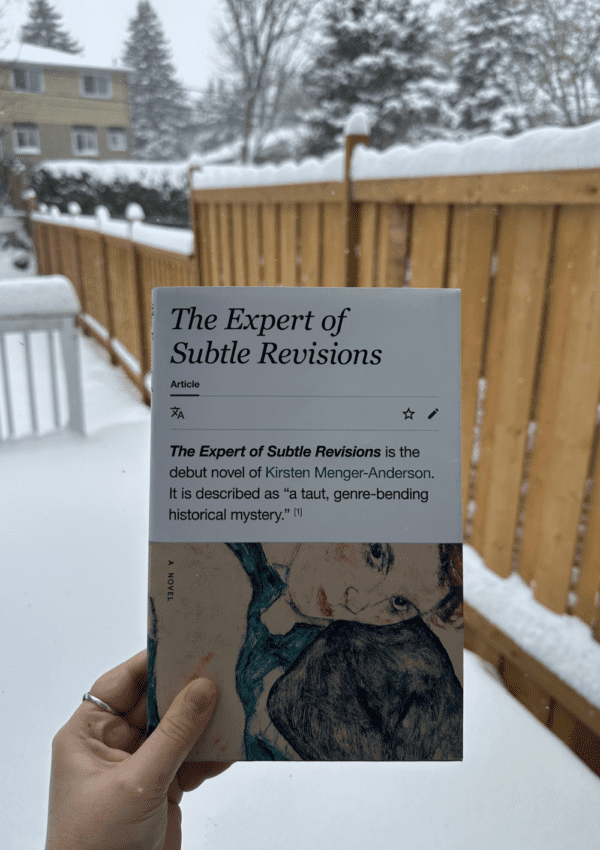

[…] You can read my review of The Sea of Tranquility here. […]