This post may contain affiliate links, which means I’ll receive a commission if you purchase through my links, at no extra cost to you. Please read my full disclosure for more information.
“Half His Age” is a novel following seventeen-year-old Waldo, a sharp, lonely, depressed, and always-wanting girl who becomes enamoured by her creative writing teacher, Mr. Korgy, who’s twice her age, married with a family, and a self-proclaimed failure.
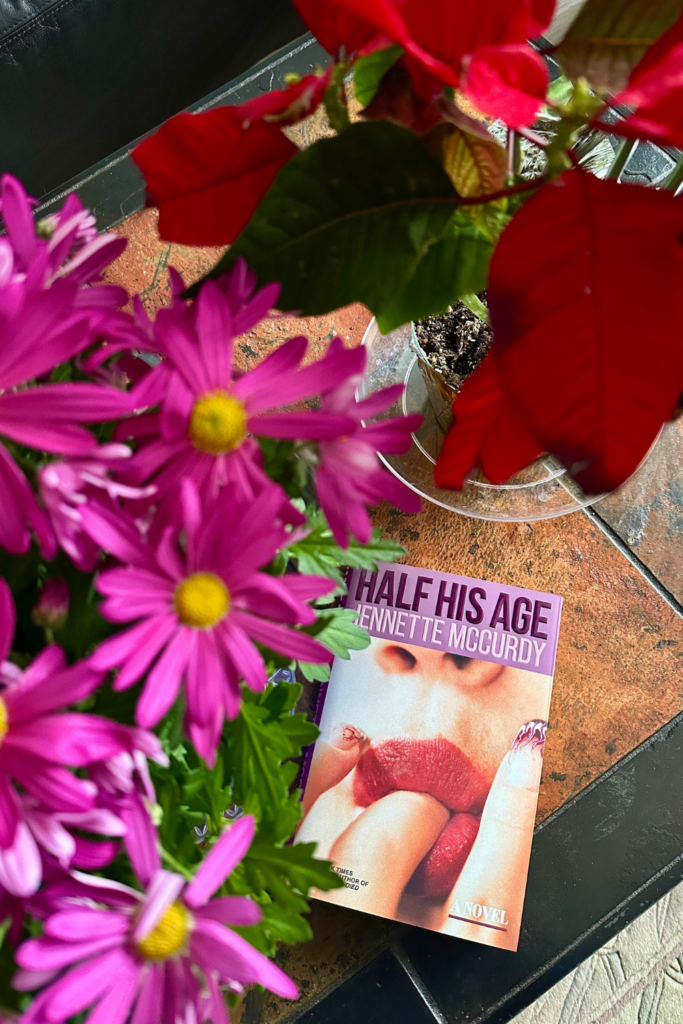
- Date finished: January 23rd, 2026
- Pages: 288
- Format: Hardback
- Form: Fiction
- Language read: English
- Series: Standalone
- Genre: Contemporary | Literary Fiction | Coming Of Age
Buy “Half His Age”
In “Half His Age,” we witness two dysfunctional and broken people who shouldn’t be together (legally, ethically, emotionally, etc.) Their connection is built on physical intimacy disguised as love and care. Although Waldo is self-aware, self-sufficient, and “mature,” we still watch as she gets tangled in Mr. Korgy’s hot-and-cold orbit. This results in Waldo measuring her self-worth by her beauty, the pleasure she brings him, and how much of his attention she can capture.
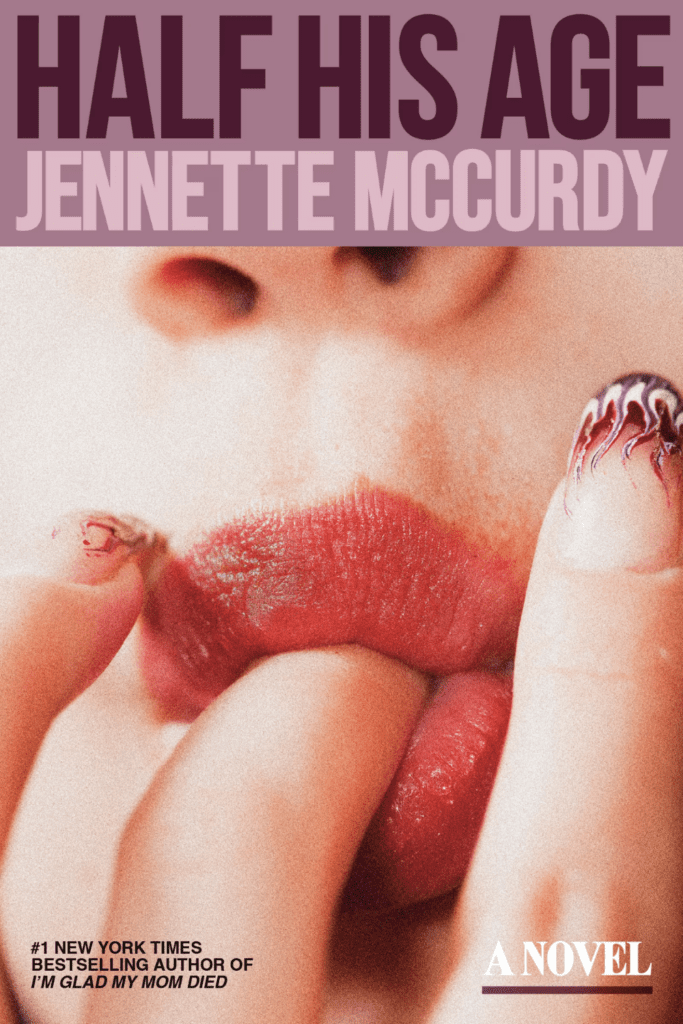
“Half His Age” is incisive, unflinching, and a modern (in a good way) coming-of-age story.
From the start, I could grasp that these are two people who are cognizant that they should not get into this dynamic. And yet, I could already feel the inevitable slippage that would cause them to transgress the boundaries. Jennette McCurdy, however, does not romanticize this relationship as she reports the good, the bad, and the ugly with zero reservations.
In a way, McCurdy is quite masterful in her incisive writing style because even though we could pity Mr. Korgy, I never got the impression that we should validate his excuses:
“No, Waldo, you deserve all of someone. Someone who can be there for you fully. Someone who’s emotionally available.”
“A seventeen-year-old? You think some beefy senior’s gonna be emotionally available between his rounds of Grand Theft Auto and his daily hour of Pornhub?”
“There are good, age-appropriate guys out there.”
“What in my life is age-appropriate? I bought my car; my laptop, my clothes, my gas. I pay the electric bill. I do the laundry and the dishes and the vacuuming. I’ve been managing my mom’s emotions since I was five. I don’t spend my days worrying about what house party I’m gonna get wasted at, I worry about if water’s gonna come out of the faucet the next time I turn it on. If my mom’s gonna be bedridden from a breakup and I’m gonna have to drop everything in my life to be there for her so she doesn’t spiral so bad she loses another job. None of that’s age-appropriate.”
“You’re right, those are things seventeen-year-olds shouldn’t have to worry about. But you’re still seventeen. And I am still a lot older than you. I have life experiences, a context for life, that can only come with age. I’ve made mistakes that you haven’t. I have regrets that you don’t. I assure you, your feelings for me will fade. Three months from now, you’ll be going to prom with your new boyfriend and you’ll be laughing to yourself about the crush you had on your crusty old teacher.”
“I don’t want a boyfriend. I want you,” I say. “And I know you want me too. We’re two sad, bored, tired, lonely people who want each other.” (pp. 94-95)
The thing is, besides the illegal and highly inappropriate nature of this relationship, McCurdy manages to explore the destructive force of a toxic relationship where a woman (in this case young girl) already from a vulnerable background (her mother had her as a teenager and they live in a trailer park) and low self-esteem, meets a man who will exploit her vulnerabilities through sexual intimacy and hot-and-cold behaviour.
In reading all of these passages, I could see some of my own experiences as a young woman desperate for the love, attention, and security I was denied in an unstable home.
We twist around so I’m on top, my knee pressing into the Cheerio crumbs ground into the seat cushion, and he tells me that I feel amazing, and he asks if I’m his good girl, and I say yes.
And then I ride him like the good girl that I am. The girl who loves him. Who only wants to please him. To make things easier for him. To be exactly what he wants. What he needs. The girl who hopes that if I wedge myself into a doll, a dream, a marionette with lifeless eyes, porcelain skin, and no needs of my own, a doll who indulges his fantasies and guzzles his cum, maybe then he will love me too. (p. 136)
All of this is intensified by women suffering under the pressure of perfection, of being the perfect object-doll to the patriarchy. We find this further emphasized by Waldo’s mother’s warnings and Waldo’s job at Victoria’s Secret. What I find incredibly fascinating is that in the sex scenes, Jeannette goes out of her way to describe not only the realities of sex: ‘Cheerios’ on the seat, unpleasant scents, and the endless uncomfortable contortion of the female body before, during, and after the sexual act. We are witnessing the continual performance of women under the unforgiving internalized male gaze.
The Race begins. The Race for beauty, for wholeness, for emerging into someone worthy, fuckable, lovable. I pray forty minutes is enough for the transformation. It’s gonna have to be. I speed through the yellow lights and roll through the stop signs to get home from school a half a minute quicker. Every second counts in The Race.
I throw whitening strips on my teeth then wet down my hair, smear in handfuls of goopy conditioner, and twist it up in a claw clip. I hop in the shower and double shave, up each portion of my body and then back down that same portion, then scrub every square inch of myself with a salt scrub that feels like the taste of wasabi as it seeps into my pores. I rinse the conditioner out and wash the body scrub off and pat my skin dry with a towel instead of rubbing to prevent redness, then massage myself with body butter and body oil and spritz myself with body spray. (p. 143)
As I mentioned, Waldo is crass (aligned with being a jaded teenager), but she’s also very intuitively aware. The power imbalance becomes increasingly obvious, and she responds accordingly, as we’ll see later.
“Can you stop taking her calls around me?” I finally ask, a few decibels too loud and with a piercing hostility.
Panic floods his face for a moment so fleeting it’s almost imperceptible. Almost. But I saw it. That look of terror, of Oh no, we’re out of the honeymoon phase where I can do no wrong. She’s starting to see through me. She’s starting to break through the surface, like all women do, all of them the same with their endless pool of wants, their infatuation all too quickly blurring into hatred.
It was a micro-moment of truth, of raw, animal emotion that he was able to edit so quickly, to correct so seamlessly that it scares me. If he’s able to manipulate his own emotions so well, what might he be able to do with mine?
“You’re usually so understanding,” he says, his face settled with a milky look of concern.
It’s a masterfully chosen phrase, a way of pinning the problem back onto me, like he’s just the timid guy trying to make sense of his girlfriend’s “outburst,” which he quantifies as any emotion that makes him remotely uncomfortable, which is any emotion that isn’t happiness or horniness. I would be impressed if I wasn’t so livid. (p. 144)
There’s also an element of misogyny, in which women dating men are expected to erase themselves, maintain the peace in the relationship, and experience the brunt of the emotional legwork. She brilliantly labels this inequality by calling it the “bifurcation of every woman”:
I’ve thought about emailing him. I’ve drafted two.
One an angrier, more aggressive hue. The other the more xoxo, no worries if not! type. The bifurcation of every woman. The split personalities.
I’ve refrained from sending them, just barely. I know that that would be a step too tar. It would be too much. The way men become paralyzed by any whiff of a woman’s more disturbing emotions. The way they can’t tolerate being needed. Or even, sometimes, wanted. (pp. 152-153)
I know some of the criticisms of this book point out that Waldo is overly analytical and jaded, but I think it aligns with Waldo and the complexity of her character. On one hand, she’s trapped in cycles of online shopping, sex, and binging processed foods because she’s stuck. On the other hand, Waldo is incredibly sharp and discerning; she’s had to take care of herself and her caretaker. So it is inevitable that once she stops rationalizing her destructive desires (aided by Mr. Korgy’s continual deception that peels away), she would finally realize that the only reason she entertained him is that she needed an escape from herself and her life.
“If this ever stops working for you or feeling good for you, we can stop. We will stop,” he says, as if it’s a kind thing to say. And I’m sure that it is. I know that it is. That he’s saying it to protect me.
So why then does it feel like a threat?
“I don’t wanna stop,” I say, my eyes hungry and wild, survival mode clicking in.
“Are you sure?” he asks.
I’m not sure how in a matter of ten seconds I somersaulted from being the one seeking reassurance from him to being the one asked to give it to him but regardless I want to stick the landing.
“I’m sure,” I say. “I don’t want to stop.” (p. 146)
Let’s not forget that Waldo has seen this song and dance done to her mother multiple times, and it is only when she’s personally experienced it that she 1) realizes she needs to break the cycle and 2) understands that her mother, despite her newfound efforts, has been stuck in this addictive, destructive cycle as a means of survival.
I noted how he carefully avoided the word breakup, choosing instead to go for more open-ended words, softer words, curated words. Break. Space. Process. Time. Friends. Recalibrate. Words that 1 know better than to believe because I’ve heard Mom relay them to me dozens of times with wild, hungry hope behind her eyes. (p. 162)
It is impossible to write a review about this book without mentioning the elephant in the room: the explicit sex scenes. Sure, at times it reads like a porno, but I believe this to be done intentionally. Let’s not forget Waldo is a Gen-Z that scrolls online and has sexually graphic content flashed at her on her screen.
The thing is, the sex in this novel is visceral for a reason — we are aware of the gross, unconformable, and ugly smells, odours, bodies, and fluids because it is realistic, unlike porn. And it is also confronting. The writing around the sex reflects Waldo’s inner state and her inner revelations. She says so herself: “Then again, the sex has never just been about sex. It’s been about what the sex has communicated to me.”
“Wow, baby,” Korgy says.
What’s wow? I want to scream. Nothing’s wow about this. You’re not wow and I’m not wow and both of us together are not wow. This is boring, sad, vanilla, tired sex. Because we’re boring, sad, vanilla, tired people. All it took to get here doesn’t matter. The forbidden love. The age gap. The broken marriage. The casualties. None of it matters. We’re not special. We’re just two people who were brought together because of how fucking lost we both were.
I shut my eyes and remind myself. It’s only sex. It’s only sex. It’s only sex.
Then again, the sex has never just been about sex. It’s been about what the sex has communicated to me. And as I ride him to completion and he explodes on my tits and goes to get a rag to clean me up, I don’t like what it’s communicating to me now. (p. 242)
The sex transforms as her relationship with Mr. Korgy morphs; it goes from something she constantly craves and wants to something mechanical. In both instances, the sex is performative, but at the beginning, her feelings were true.
That’s what sex is for me now. Recreating—or attempting to recreate—how things were in the beginning, when sex represented the affections, the desires, the wishes, hopes, and dreams.
The longing. The promise of what could be. The chemistry. The potential. When sex represented all the things we couldn’t say.
Now, sex represents the apologies, the differences, the disconnection. The mourning. The acceptance. The melancholy for what used to be. Still the things we can’t say. Just different things. (p. 251)
This is also what happens when sex is the primary mode of communication: it becomes the last thing to go, and when it does, there is nothing left of that initial relationship whose intimacy was built on a house of cards. In this matter, it is Waldo’s body who intuits and knows before her brain does.
I go to reply, to tell him I’ll be there in a sec, but my body won’t let me. It’s frozen. I try to override it, to shove my body’s instincts down. Tell them to be more quiet. Be more right-sized. Be more appropriate and more reasonable and less of a nuisance. Only I can’t And beyond that, I don’t want to. Because my body knows more than I do. My body’s instincts are loud. And they’re right. And they’re appropriate and reasonable and they are not a nuisance.
They are wise. They are giving me all the information I need.
I put my hand on my heart. My tender, sensitive, strong, roaring heart, and I thank it. I leave the restroom, rolling my suitcase behind me, and I walk in the opposite direction of the gate, toward the exit to the airport. walk past restaurants and candy shops, perfume stores and clothing boutiques, and I don’t look at anything. I walk past it all. (p. 270)
Finally, this novel had one of the best endings I’ve read in a while. It’s not perfect because this is not a perfect world, but it is perfect for Waldo’s character arc. The realisation that all of these compulsions are actually disguised as wants because her needs growing up were never truly met. And as she steps into adulthood, she will have to confront these needs without replacing them with wants disguised as bad actors.
My hand’s out the window like a singer in a nineties music video.
I yank my hair tie out and let my curls blow in the wind. I’m halfway to Seward, a dozen calls deep from Korgy and six from Mom, when I finally shut off my phone.
Maybe it’s all the same. Korgy and pants and YouTube and makeup and sweaters and junk food and sex. Maybe they’re all just distractions from me. But right now, me feels okay. No chaos, no turmoil, no endless list of wants. Right now, I don’t want for anything. (p. 273)
For me, this novel was brilliant.
I will continue to read anything Jenette McCurdy writes!
On the drive up to Beluga Point, he tells me about taking Russian in high school and how he spent six weeks there after he graduated. The Kremlin was, as he expected, just an underwhelming tourist trap. But he did love the borscht. He goes on a rant about how refining your artistic taste is the second most important thing to finding your artistic voice, then tells me about authors I should read—Chekhov and Tolstoy and George Saunders and David Foster Wallace—and filmmakers I should know—Bergman and Kubrick and Kurosawa, Lonergan and Linklater and Solondz.
I’m used to the person I’m dating, or sleeping with, or whatever it is, telling me all the things I ought to know instead of getting to know me. It’s how men, or boys, or both, communicate.
They quote and they riff and they rant and they explain and they explain and they explain.
But with the others, it’s been cringey—Randy Julep quoting Joe Rogan or Paul Bornstein ranting about Michael Bay’s cinematic prowess. Korgy’s a different breed: a learned man with good taste and well-honed perspective and hard-earned life philosophies. There’s a wisdom to him. And a sadness I find hard not to trust. (p. 127)
His parents give me a brief house tour. They’re fully equipped with polite small talk and an invisible but palpable air of stability. It’s in their settled eyes, their understanding head nods, their courteous, boundaried phrasing. This explains Nolan. People who come from functioning families just don’t have the same charge as the rest of us. Functioning familes make for boring flavorless people who just go through the motions of life, never knowing what it really means to live it.
Or maybe that’s a false narrative I cling to in order to feel better about my dysfunction. My lot in life. Myself. Maybe coming from a functioning family doesn’t resign someone to a bland, muted, watered-down existence. Maybe it’s better. A lot better Maybe that person learns how to navigate their emotions more effectively, and not be led by them or ruled by them or so disrupted by them all the goddamned time. pended by them.
Maybe that person learns how to communicate better, and how to curb impulsivities, and fit into systems, and be more okay, and grin even as bullshit is being shoveled into their mouth, and keep grinning as they chew that shit and swallow it, letting the sludgy stream slide down their throat. (pp. 184-185)
⭐⭐⭐⭐
Leave a Reply