
This post may contain affiliate links, which means I’ll receive a commission if you purchase through my links, at no extra cost to you. Please read my full disclosure for more information.
“The Expert of Subtle Revisions” is a dual timeline narrative — in 2016, Half Moon Bay, California, we follow a young woman with no social identity, who’s investigating the sudden disappearance of her enigmatic father; and in 1933, Vienna, we follow a young man who accepts the post as a mathematics professor in a tense anti-academic and anti-semetic atmosphere during the rise of fascism; in the same timeline, we follow another young man, a painter-turned-server who’s ambition knows no bound.
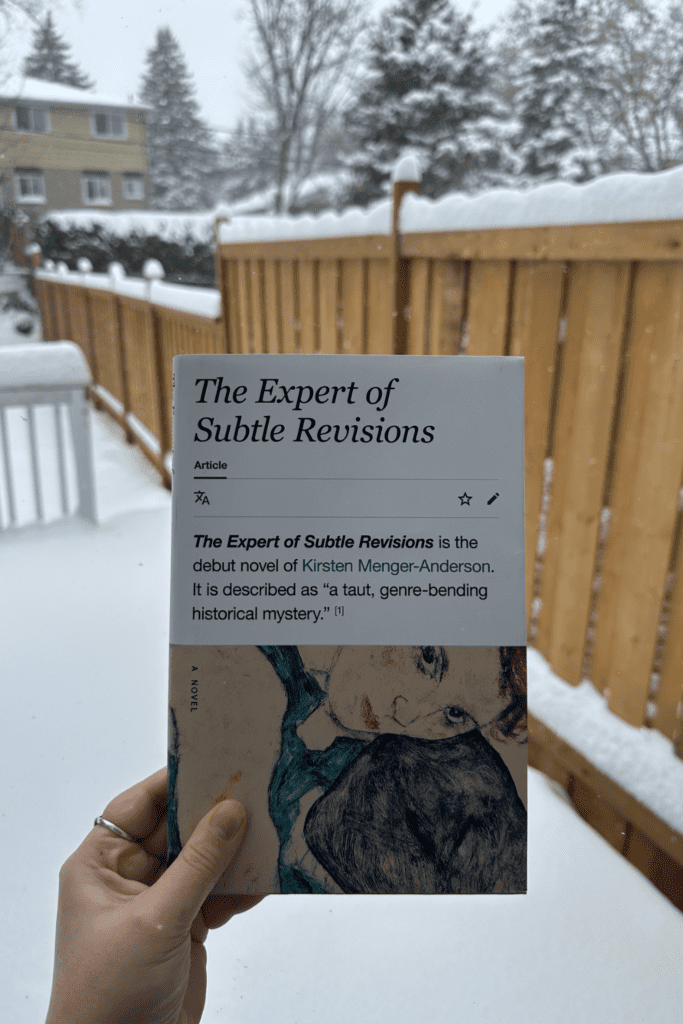
- Date finished: February 16th, 2026
- Pages: 256
- Format: Hardback
- Form: Fiction
- Language read: English
- Series: Standalone
- Genre: Time Travel | Science Fiction | Historical Fiction
“The Expert of Subtle Revisions” is a dual timeline narrative — in 2016, Half Moon Bay, California, we follow a young woman named Hase with no social identity, who’s investigating the sudden disappearance of her enigmatic father and finds relief in editing Wikipedia pages; and in 1933, Vienna, we follow a young man who accepts the post as a mathematics professor in a tense anti-academic and anti-semetic atmosphere during the rise of fascism and who is invited to join Engelhardt Circle, an elusive intellectual group admist the rumors a time-travelling music box operated by mathematical mechanics; in that very same timeline, we follow another young man, a painter-turned-server who’s ambition knows no bound.
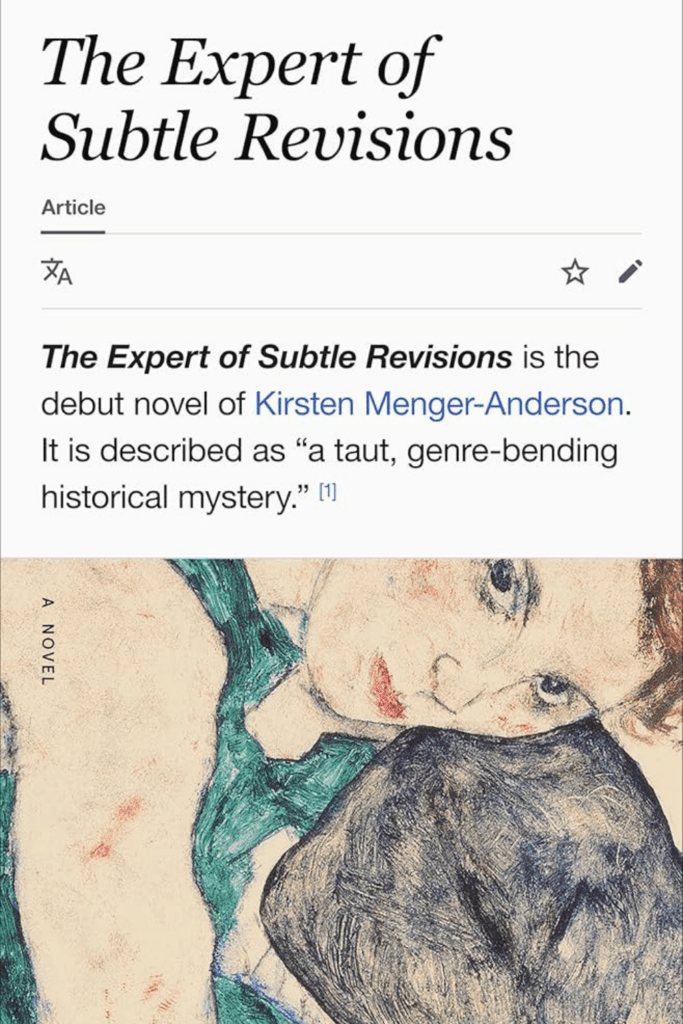
First off, “The Expert of Subtle Revisions” has one of the most interesting and stunning covers I’ve seen. The painting on the cover is by the Viennese painter Egon Schiele; it’s his Seated Woman with Bent Knees, framed by a Wikipedia page of the book’s title (which is relevant to the story).
It’s simply brilliant!
Had I not been researching recently published time-travel books, and had I simply seen the cover of this book, I would have still ordered it on impulse.
This novel also reminded me of two of my favourite recent reads, which coincidentally are time-travel narratives, “The Ministry of Time” and “The Sea of Tranquility.”
You can read my review of The Sea of Tranquility here.
From the very beginning, we get a sense that our first main character, Hase (in 2016, Half Moon Bay, California), is outside of the plane of time and existence with no historical record to her name. She even takes on different names and was given that name by her father, Haaza (from the German, meaning rabbit, p. 14) :
As far as official records go, I do not exist. There is no history of my life: no bank statements, no credit cards, no driver’s license or passport.
I have no birth certificate, no Social Security number, no pay stubs, no tax returns. No close friends, aside from Harriet, and Jake, who isn’t particularly close. My only family is my dad, who isn’t my biological father.
There is no adoption record, of course.
Call me Hase. Names are like lipstick or to-do lists. I have many. I choose one that suits my mood. For now, I choose Hase, because my father calls me that. I’m waiting for him, searching the horizon for his boat, the wind tangling my hair and clothes, the ocean lending me its odor. Here, I am Hase.
Elsewhere, I go by other appellations. The strangers who ask for my number or offer to buy me a drink call me Grace. The children I tutor call me Ms. H. On Wikipedia—I contribute as a hobby (anyone can, few do)—I go by TheRabbit, though I’ve used many handles there, most banned because I break the rules too frequently.
Untrustworthy, the editors call me.
For what it’s worth, I don’t trust them, either.
Today is my birthday. It’s not the day I was born, but I always celebrate on June 11 because eleven is my favorite number and June has the longest days. Dates mean very little, my father taught me. You might as well choose a day you like.
And I did. (pp. 1-2)
We understand from the following exchange that story elements in this novel will be hidden in plain sight, as is the case with the second character, Anton Moritz, who we later discover is actually her foster father and the lover of time-traveler Haskell Gaul.
As a child, my father and I celebrated June 11 with Jell-O that I’d mold into shapes—a heart, a fish, a house—using pans we found in thrift stores. Each year, I picked a different shape and my father made up a story about how the next year would be informed by the Jell-o duck, or flower, or ghost.
I haven’t eaten Jell-O since I moved to San Francisco, nor has my father told me a story, but as I wait for him at the dock, I think of the last time we celebrated. That story, for my nineteenth birthday, concerned a rectangle. At the time, I considered the rectangle dull if not disappointing after years of animals and hearts, but my father insisted it was a perfect form.
“A box will not look special if you don’t open it.”
When I pointed out that I couldn’t open the Jell-O rectangle, he told me that humans are constrained by the limit of their imaginations.
In truth, I don’t think I ever liked the taste of Jell-O; I’m simply fascinated by how the powder dissolves into water and how the water then becomes solid. The solid is neither rigid, like the mold, nor hard, like the table beneath it. However, these qualities did not prevent my father from telling the story of the Jell-O box, which served as a safe with no need for a lock, as no one thought to open it.
My father has never cared for the saying “hiding in plain sight,” and the story of the Jell-O box is the story of why. The treasure inside the Jell-O box was not in plain sight. It was hidden by our failure to see beyond what we already know.
While my father told this final birthday story, I stared through the lemon-yellow Jell-O to the plate beneath. There was no way there was a treasure inside. (p. 2)
Going back to Hase, I found her to be a compelling character. She lives a lonely life, mostly modelled by her paranoid father (with reason). This aspect of the book truly made me reflect on the fears, traumas, and habits of living we adopt from our primary caretakers.
Deep down, it is evident that Hase desires to leave some kind of mark, though she doesn’t really know how to. Hence, her obsession with contributing to Wikipedia pages, in which she can change, alter, and record facts that would otherwise be obscured.
Her “hobby” of editing Wikipedia pages can be quite compulsive, a way for her to regulate her emotions and control, at the very least, something in her life:
Now, however, I feel useless.
If I had my laptop, I’d go online. Online, I don’t forget my problems, but I can set them aside. I can sit in front of a keyboard convinced that I’m elsewhere. Online, I’m welcome until I’m not, usually because I’ve assumed an influential role—a forum moderator or administrator—and abused my power. My last Wikipedia bot inserted the words “History is not neutral” on several dozen pages before it was suspended, along with me. (pp. 24-25)
It is also through Hase that we experience how both history and language are not neutral. Erase or edit someone’s story, and you can just as easily erase or edit history.
Online, I can always return. I just have to create a new account.
Usually, when I’m feeling anxious, I edit Wikipedia or browse the deleted pages—drafts left too long untouched, content flagged as promotional or libelous, biographies deemed unworthy of note. I’m one of a handful of people who reads this shadow history. Most people don’t even know it exists, but I’m a connoisseur of untold stories. There’s a man whose biography has been deleted dozens of times. He claims he invented the blockchain, and sometimes he adds that he discovered DNA as well. I’m not sure if he believes these things, or if he’s testing the limits of what he can get away with.
Over the years, I’ve deleted pages, too—sometimes because they are plagiarized; sometimes because they are duplicates; sometimes because they don’t sit right with me. Twice, I deleted every page created by an editor who displeased me. Once, I was censured for this. Once, my deletions remained.
History can be this personal.
Most of my changes are subtle, however: details no one cares about, changes that draw no attention. I don’t add lines; I shift language, the pattern of subjects and verbs, the verbs themselves:
killed to murdered
riot to protest
she was beaten to he beat her
Language, too, is never neutral. (p. 25)
Once again, this is done intentionally, as we understand that a large part of Fraulein Popovic (Hase’s actual mother) gets erased from Hase’s life, only to be forever remembered in a measly locket. Leading Hase to believe that her mother abandoned her, when in reality she was ripped away from her mother because of the actions of the men of Engelhardt Circle:
I finger my locket. The metal is even colder than my skin, but I play with it when I’m uncomfortable. Inside is my mother’s picture, a photo of a portrait cut from a book. On the back of the page is a portion of a stranger’s cheek.
Her portrait is done with a fine brush, the colors vivid and absurd—green for the lips, deep blue around the eyes—but is somehow more real than a photograph. I’ve spent hours tracing the brushstrokes. She would have wanted you to learn math. She would have wanted you to learn German. She’d want you to be strong, and wise, and kind, just as she was. My mother is a laundry list of wants, a fantasy composition of desire. If she truly wanted so much for me, she never would have left.
The woman in the portrait wants something unspoken, something I will never know. All I have of my mother is this necklace, and I wear it relentlessly, as if to prove to an indifferent world that she belongs here as much as I do. (p. 5)
It wouldn’t be a complete review if I failed to mention the other two characters we follow in this story (Anton Moritz and Josef Zedlacher) in 1933 Vienna. As I mentioned previously, we gradually discover that Anton is Hase’s adoptive father by circumstance. He gets involved with Haskell Gaul, and their love story must be hidden from Josef, who’s a Nazi sympathizer and preys on people’s secrets. In this case, the queer identity of Anton has been exposed. In this matter, the race against time is also a way to revise history and protect their identity:
We’d shared everything we knew about the problem—the work he’d done on the music box before we met, the pages I’d given him in Vienna, and the ones I’d done since then.
“You will solve this before anyone finds us,” he assured me. We were working together, my work relied on his, and yet, it was my spiral that promised an answer, a path forward or, rather, a path back.
The Return: I’d wind the completed music box and meet Haskell outside the gathering of Engelhardt’s circle. He would have just arrived—as he had—knowing his music box was only half finished, only able to carry him one way. But I would carry the finished box to him, complete after years of repairs and work, and return it before he walked into the Engelhardt circle and my heart fluttered. I would return the box like a library book, a borrowed story, a life lived vicariously.
We’d see each other—I an old man, he a young one—but only for a moment. Then he would wind the box and return to San Francisco.
Just like that, we’d complete our circle. Our spiral, as he liked to call it, because a circle, unlike life, has neither beginning nor end, and is—should one repeatedly follow the course of its perimeter—alarmingly dull. He’d leave Vienna before he crossed paths with anyone, before a new melody played. He’d erase everything that once had followed. The song—this song—would never again play. (p. 216)
Together (Anton & Haskell), they can rewrite history but history is never a perfect math equation, as they did not factor in Hase’s involvement in their current timeline.
Time travel stories are always flawed, but what matters is whether the ‘payoff’ is satisfactory; we can continue to suspend our disbelief, especially if characters have been changed or transformed by time travel.
The other thing about time travel is that it can highlight revisionist history, such as Josef taking credit for Anton & Haskell’s work by creating an entire institute for himself:
According to the Wikipedia page, translated from the German Wikipedia not long before, the Zedlacher Institute was founded by Josef Zedlacher in Vienna to “advance the science of time travel.” The key “evidence” supporting his claim that we could travel through time was the work of a man named Haskell Gaul, who arrived in Vienna in 1933 from an unknown point in the future. Zedlacher claimed he witnessed a man “disappear in time” by winding a music box designed by Haskell Gaul and that he had searched for it ever since.
The Wikipedia page linked to Harry Houdini, who made an elephant disappear, and David Copperfield, who convinced his audience that he’d moved the Statue of Liberty, both added by an editor named FrogPrince, who also wrote: “People see what they are led to see. People believe what they wish to believe. I do not believe people can pop into the past as if it were a corner store. If anyone winds a box and disappears, it is illusion.” This text had been removed and added to the page several times, and I deleted it once more, calling it “opinion.” (p. 21)
There are dire consequences over time created by figures like Josef. For example, when Hase was younger, a graduate student who thought of himself as Haskell Gaul stayed up for long and died of sleep deprivation. And then, over time, many claimed to be Haskell Gaul, which has led to Anton’s increased fear and paranoia. The same fear and paranoia that entraped Hase, an innocent child and bystander who has grown up in the shadow of these male figures.
Josef has always had an interest in secrets, transgressions he discovers—overheard in the café or late at night when he walks home: Professor Leitner is having an affair with a student, Professor Fuchs has fallen in love with a prostitute, a Jewish student has lied about his last name.
Most are shared in hushed voices, but Josef arranges his body so that he can hear, leaning over a table to wipe a second time or preemptively sweeping up crumbs of pastry. Secrets are valuable. He dutifully reports each to the administrator, and the administrator returns this favor with a small sum that Josef discreetly pockets. (p. 80)
As for Josef Zedhlacher, the era of Nazi sympathisers is the perfect breeding ground for his untethered ambition. His sociopathic mind believes that everything is owed to him; the teaching post that was given to Anton, the beautiful smart woman in their circle (Fraulein Popovic), the time machine constructed by Haskell, etc. He’s determined to solidify his status as a noble genius in history when, in reality, all that he contributes is a Reign of Terror. The irony is not lost on me. He is portrayed as a great painter (much like Hitler was), as he is the one who made the beautiful portrait of Fraulein Popovic that Hase carries.
And finally, the past and future timeline unite once again. We understand that the tune in the music box time machine was composed by Sophia’s mother (which would have been Hase’s grandmother). The Wikipedia editor who confronts Hase is Manifold, who is the real Haskell. In the end, it’s a bit confusing: Hase’s father goes back to his true age and self as Anton and he leaves behind his journal for Hase (her name given by birth from her mother is Vera), and Hase-Vera ends up travelling back with Manifold (Haskell) to see her mother and adoptive father and to even see herself as unborn then born in the past timeline.
The last message he sent to me was from an anonymous IP address. I don’t know where he is or it he is alive.
Is he still running? Still hiding? After all these years. Is he so afraid of Josef Zedlacher that he would deny himself the opportunity to be with both me and the man he loves?
History is easily erased, but it can also be rewritten. Why wipe away change to leave a broken thing intact?
The key is warm between my fingers. I turn it a third time, then a fourth. I feel the resistance strengthen.
The fifth time I turn the key, I hear a click.
The music box plays, but I hear the melody from my father’s lips, the song so sad, my tears come, unbidden. When I was a child, this song was my lullaby. When I was feverish, my father sat beside my bed, humming this tune. I know it as if it is part of me, an organ pumping blood or releasing bile.
Why shouldn’t I be the one who writes the story? Why shouldn’t I decide my own fate? Or that of my father, who would have, had he not failed, removed me from the tale entirely?
I am an expert of subtle revisions. Line by line, each word a choice: “she accepted” or “she chose,” “they parted ways” or “their ways were parted,” “he wrote a letter” or “the letter was received.”
Words are like brushstrokes; details become facts. I can paint a picture like the one in my locket. Complex and beautiful. Surprising.
The sensation I have is not unlike falling.
My muscles shake.
I take a deep breath, feel air fill my lungs. I hear footsteps and the sound of a door snapping shut. I’m not sure if I’m inside or out, but I’m not in the garden. I no longer smell the roses.
I clutch my father’s journal and the music box. My shirt clings to my skin.
If I arrive in Vienna, I’ll be a stranger. But I will have this story, and I won’t let them erase it—not all of it. Not the parts that deserve to unfold.
I feel cold and then feverish. And then a flash of light. (p. 233)
Although we follow Anton and Josef, Hase’s voice is the most memorable for me.
Maybe it’s her relentless grip on not being forgotten, maybe it’s her unexpressed anger. Maybe it’s her lifelong repression that makes her so compelling.
All in all, confusing as it might be, she regains agency by integrating herself into her father’s past, refusing to be erased or forgotten. She even gets to spy on her mother from a comfortable distance. The ending is bittersweet and abstract in many ways. It’s definitely a book worth rereading!
My father wouldn’t forget my birthday. And yet, he has. Did he fall and hit his head? Did he have a heart attack? I don’t know what I’d do without him. He’s the one person I trust completely.
I force the darkness from my thoughts. It’s my father’s paranoia, not mine.
When I return home, I will find him on the ham radio he and I keep tuned to the same frequency. He’ll wish me happy birthday. He’ll apologize and ask how I celebrated. We don’t talk every night, but he’s always there, like the city map I bought when I first moved to San Francisco and now pull out only when I’m lost. (p. 6)
“Haaza,” he said, the German pronunciation for the German word for rabbit. “Haaza,” the way I say my name, too. (p. 14)
⭐⭐⭐⭐



Leave a Reply