This post may contain affiliate links, which means I’ll receive a commission if you purchase through my links, at no extra cost to you. Please read my full disclosure for more information.
“A Life of One’s Own” is part memoir by Joanna Biggs, recounting her starting over after her divorce, and part biographical exploration of the path to independence and intellectual freedom carved by nine famous women writers who also began again (notably Mary Wollstonecraft, George Eliot, Zora Neale Hurston, Virginia Woolf, Simone de Beauvoir, Sylvia Plath, Toni Morrison, and Elena Ferrante).
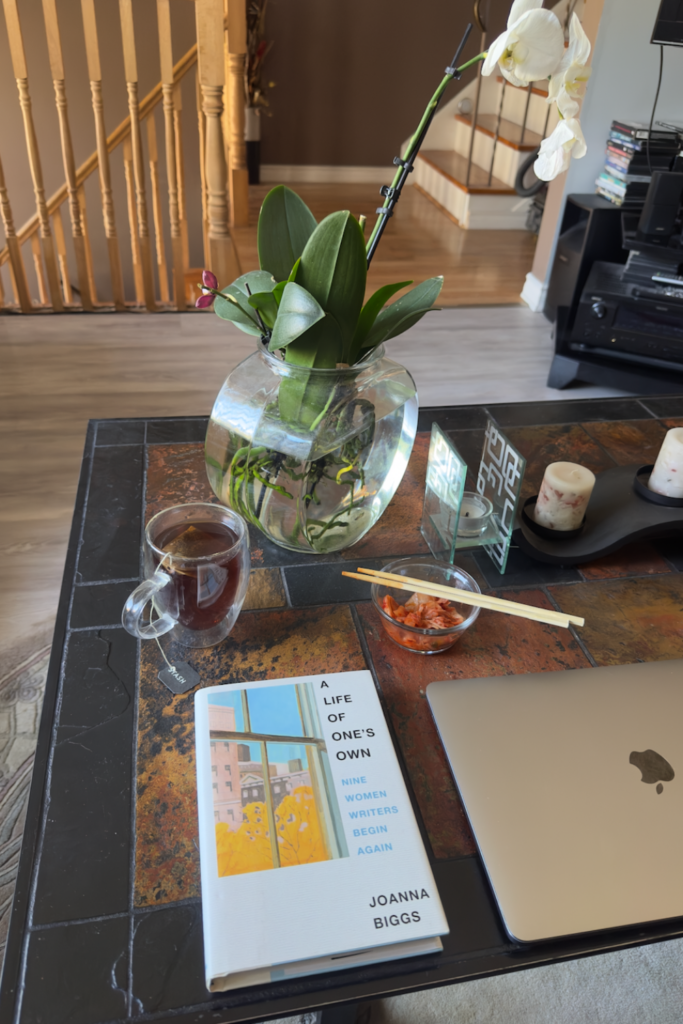
- Date finished: March 29th, 2026
- Pages: 272
- Format: Hardback
- Form: Non-Fiction
- Language read: English
- Series: Standalone
- Genre: Memoir | Feminism | Writing
“A Life of One’s Own” is part memoir by Joanna Biggs, recounting her starting over after her divorce, and part biographical exploration of the path to independence and intellectual freedom carved by nine famous women writers who also began again (notably Mary Wollstonecraft, George Eliot, Zora Neale Hurston, Virginia Woolf, Simone de Beauvoir, Sylvia Plath, Toni Morrison, and Elena Ferrante).
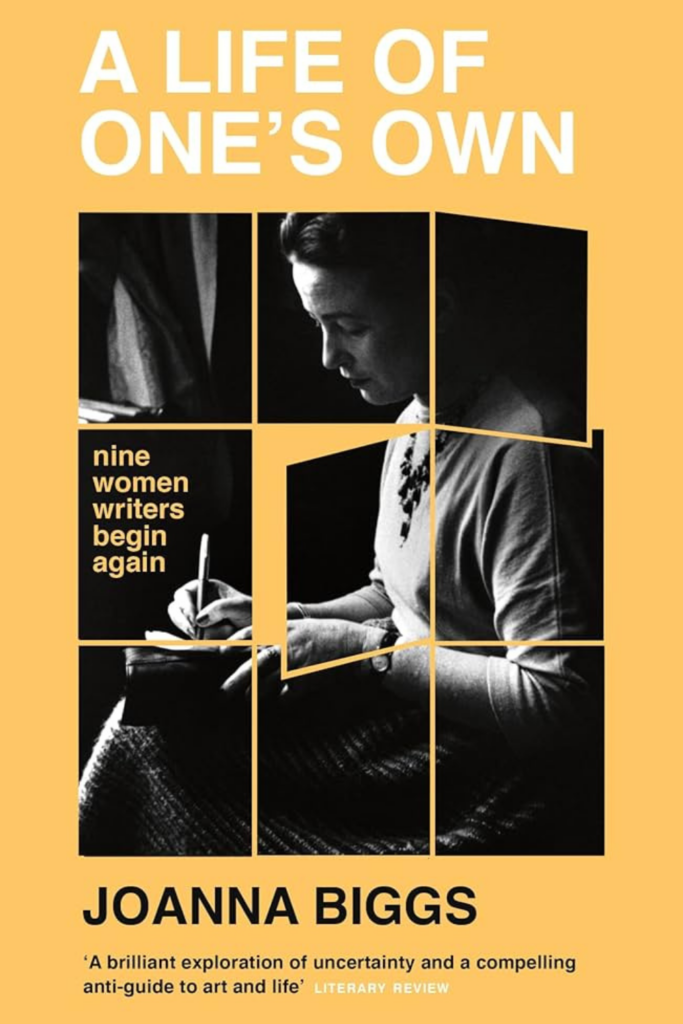
Joanna Biggs cleverly uses the memoir genre in “A Life of One’s Own” by paralleling her personal journey of starting over after her divorce with her extensive survey of accomplished, famous women writers who have begun again despite a society that oppresses their voices.
We are first introduced to her personal journey with women writers in the First Chapter on Mary Wollstonecraft, cementing Biggs as a devoted reader of women writers in her early twenties while completing a degree in literature at the University of Oxford:
On my first reading of the Vindication as a twenty-year-old undergraduate, I looked up the antique words and wrote down their definitions (to vindicate was to “argue by evidence or argument”). I followed Wollstonecraft’s case for female education. I knew she’d been a teacher, and saw how reasonable her main argument was: that you had to educate women, because they have influence as mothers over infant men. I took these notes eighteen months into an undergraduate degree in English and French in the library of an Oxford college that had only admitted women twenty-one years before. I’d arrived from an ordinary school, had scraped by in my first-year exams, and barely felt I belonged. The idea that I could think of myself as an intellectual as Mary did was laughable. Yet halfway into my second year, I discovered early women’s writing. I was amazed that there was so much of it—from proto-novelists such as Eliza Haywood, aristocratic poets like Lady Mary Wortley Montagu, and precursors of the Romantics like Anna Laetitia Barbauld—and I was angry, often, at the way they’d been forgotten—or, even worse, pushed out of the canon. Wollstonecraft stood out, as shed never been forgotten, was patently unforgettable.
I longed to keep up with her, even if I had to do it with the shorter OED at my elbow. I didn’t see myself in her at the time. It wasn’t clear to me when I was younger how hard she had pushed herself. (pp. 11-12)
Biggs does a great job linking these women writers and putting their lives into a greater context. But what I found particularly hopeful was her decision to demonstrate that women can find happiness and literary success, regardless of their age.
For example, George Eliot finds both love and writing in middle age:
Mary Wollstonecraft died at thirty-eight, but George Eliot was born at the age of thirty-eight. Jane Austen assisted at the birth: the year Mary Ann Evans was beginning to write fiction, after several years in London editing a magazine and writing essays, she looked at all of Austen’s novels again, starting with the last, Persuasion. She read them out loud during the evenings she spent with George Henry Lewes, whom shed recently asked to critique Austen—”the greatest artist that has ever written,” he wrote—for the magazine she worked for, the Westminster Review.
Lewes was rapidly becoming essential to her: to her happiness, to her sense of herself as a writer, to her confidence. For years, Evans had put aside her first attempt at fiction, a descriptive passage about the Staffordshire villages she knew as a girl, along with the hope that she could write imaginatively. She doubted she could write dialogue and construct the sort of conflict that drives a plot. But ought she not to try? Lewes argued. It could be a failure, or it could be an instant chef d’oeuvre. A title for a story about a sad clergyman came to her while dozing in the morning. She wrote successful dialogue for it, but still wondered if she could summon up pathos. Say Lewes went into town on purpose later in the week, and she tried to write a funeral scene? When Evans read it to him when he came home, they both cried, and at the end he went up to kiss her. George Eliot had been born. (The name gave cover, but also comfort. At the very beginning of her career Lewes would be there with her, in the first name “George”—but so would Austen, in the surname “Eliot,” also that of the heroine of Persuasion, Anne Elliot, whom everyone in that book thinks (wrongly) too old to catch and keep happiness.) At the end of that year, 1857, Eliot wrote in her journal: “Few women, I fear, have had such reason as I have to think the long sad years of youth were worth living for the sake of middle age.” (pp. 37-38)
She also connects this to her own maturity and evolution, both as writer-reader and woman who has faced loss and heartbreak:
Like finding your great love at thirty-seven, or discovering that you are a fiction writer at thirty-eight, there is some guilt, along with delight and shock, in the change of fortune. Whenever I go to Eliot, then at seventeen and now at thirty-eight, I am surprised again. had the sense when I first read Middlemarch that I was missing things, that would need to read it again when I was older and had lived some more. Now that I have lived more, the novels irony comes through, and it seems funnier than it did. (p. 41)
After her divorce, Joanna Biggs leaves her homeland of England and braves New York. It is then that she truly understands what Virginia Woolf feared — during the last few months leading up to her suicide — the feelings of being stuck and powerless in her life:
I hadn’t thought of newness as sustaining before, or as important to happiness. But I kept discovering that I was happy in New York, in tiny and large ways, and so it was in the subway car that I understood why Woolf felt she couldn’t live without the feeling, once she’d stopped believing that it would come again. I’d cried earlier that day on reading Hermione Lee’s account of Woolf’s suicide, and I understood then why I had: not just because I would have to let Woolf go as I came to the end of the biography, but for Woolf as a woman, and for me myself, who had been so lost. I too had felt that nothing would change—but I had been wrong. And I was so relieved to be wrong. (pp. 109-110)
I also particularly enjoyed that Biggs drew attention to the relationships and marriages these women were in. Oftentimes, these women were in some kind of unconventional yet supportive relationships with other writers (Mary Wollstonecraft and William Godwin, George Eliot and George Henry Lewes, Leonard and Virginia Woolf, Simone de Beauvoir and Jean-Paul Sartre, Sylvia Plath and Ted Hughes, etc.)
As a writer myself, I’ve always been intrigued by these dynamics. (My own modern version, when I was a young adult, happens to be the marriage between YA writers Tahereh Mafi and Ransom Riggs.)
Woolf proposed in January 1912, but thirty-year-old Virginia was unsure of her answer until late April, when they first kissed on the cliffs above Eastbourne. She wrote to him on May Day, dithering still, worried that she was unstable, that he wanted her too much, that marriage was too conventional, that she felt no physical attraction to him, that she ran hot and cold, that he felt too foreign. “We both of us want a marriage that is a tremendous living thing, always alive, always hot, not dead and easy in parts as most marriages are. We ask a great deal of life, don’t we? Perhaps we shall get it; then, how splendid!” On the threshold of convention, she hesitated, hoping that in this interzone between marriage and not-marriage, they could make something new out of the institution: a modernist marriage. They wed that August in St. Pancras Town Hall, during a thunderstorm, and maybe they did get the sort of partnership Virginia wanted. It was a marriage that gave her room to fall in love with women, that could care for her when she was sick, that produced the Hogarth Press, that allowed her to write eight novels and many other books before she fell ill for the last time. It has never felt like a romantic match to me—Lee proposes that it was brokered by Strachey, and notes that it was never passionate—but what Virginia wrote in her last letter to him, that no one could have done more than he had done, seems right. He reminds me of Lewes, Eliot’s partner, in that he took his responsibility to Virginia’s writing seriously. Lewes protected Eliot from other people’s opinions, and Leonard was Virginia’s crucial first reader. To the Lighthouse, he said, was a “masterpiece.” The Waves was also a “masterpiece,” and the “best of your books.” It barely matters that he repeated himself in his praise because he kept her writing. I wouldn’t want to say that these men were male muses, as I suppose I’m cynical about the role of the female muse—who wants to be a Véra, even to a Nabokov, anymore?—but I am interested in marriages that are set up in a way that supports the writing and the happiness of both people in it. I collect anecdotes, which I then idealize: Mary and Percy Shelley wrote a book together on their honeymoon; Kazuo Ishiguro reads his work in progress to his wife, Lorna, at the end of the day; Elsa and Norman Rush treat Norman’s novels like a family business. My own experience of being married to another writer was full of disguised envy; I know such alliances are delicate and difficult. Yet I keep hoping I can find something that might work for me; I keep looking for examples that work for others. It’s an old habit, wanting to learn something from books that I need to try out in life, to go over a thing in my head many times that I know must be made in the world. (pp. 112-114)
This is further emphasized in the Sylvia Plath chapter, in which one of her past boyfriends had said to her, ‘men create art; women create people,’ illustrating how truly difficult it was for these women writers, who fought in their personal lives, let alone literary lives, to break the shackles society had fastened for them.
Gordon was going back over their discussions the previous summer, and he wrote to apologize for saying that “‘men create art; women create people.’ When I think back on it it seems to me such a crass and mean statement… I realized that women had not been given any near approximations of the opportunity for learning as man had until practically this century.” Women writers need to know about their foremothers so they can answer back in conversations like these: yes, George Eliot and Virginia Woolf and Mary Wollstonecraft and Zora Neale Hurston and Simone de Beauvoir existed, and everything they wrote was in spite of the societies that were skeptical of their desire to write, and to live the way they did. How can you know what you could be without some knowledge of those who have done what you fear you can’t? In The Bell Jar, Esther is warned that having babies will remove the desire to write poetry entirely. (p. 179)
Slowly, as Biggs works through these women writers, comparing her personal anecdotes and struggles to theirs, we watch as she forms her true thesis. It is especially stark in the chapter about Simone de Beauvoir, as she uncovers that Beauvoir herself refuted her behaviour as a feminist and her career as a philosopher. Beauvoir, the supposedly feminist icon, “seduc[ed] her pupils and then pass[ed] them on to Sartre (p. 136.)
However, although the idea of her as a “feminist heroine ha[d] faded” (p. 136), Biggs later rediscoveres Beauvoir in a brand new light:
She spoke this time as a woman who had attempted to live freely, and she felt like an aunt, a mother, an elder. I found that she hadn’t claimed any superhuman status for herself: “I wanted to make myself exist for others by conveying, as directly as I could, the taste of my own life,” she wrote at the very end of Memoirs of a Dutiful Daughter. Simone “communicates emotionally at once,” Sartre wrote. “People are always involved with her by virtue of what she says.” She herself said that she wrote about her life to ask: “What have I done with my freedom?” She wasn’t seeking exoneration or canonization, but to live—with all the messiness that implied—on the page. She didn’t even come to memoir until late in her life. Could she have been unsure what value there was in telling her own stories when philosophy and fiction could offer people rather more than her own example? And if I hadn’t grown out of wanting to learn a lesson from her life, might the real lesson be the harder one—to value her for the mistakes she made as much as for what she achieved, and to accept that they might even be intertwined? (pp. 137-138)
Only when we start seeing others in a greater context can we examine our own lives (shortcomings and successes) in the same manner. This not only stresses the importance of rereading but of constantly recontextualizing as well. Biggs openly states this in her final paragraph:
Surely the best lesson these women writers, my friends and teachers, have for me isn’t that I should copy them, but rather that I shouldn’t. Their example exists not in order that I might slavishly follow it but so that I might develop the confidence to let go of them and become the author of my own life. I know that the decisions I make might have consequences I don’t intend, and all I can do is promise myself that I can and will deal with those consequences when they happen. The ultimate freedom might be to take the wreckage of your life and write your own story with it. That’s one thing that Mary, George, Zora, Virginia, Simone, Sylvia, Toni, and Elena all offered themselves, and it is something I can offer myself. You can too. (pp. 252-253)
If you return to the first quote I shared, which belongs to the first Chapter on Mary Wollstonecraft, we witness her growth from copying and idealizing (when she was an undergraduate in Oxford) to understanding and joining (when her divorce broke apart in her middle age) the walk alongside these women, making her own mistakes and writing her own life while forging her own path.
When Eliot first began to write fiction, she wrote that “art is the nearest thing to life; it is a mode of amplifying experience and extending our contact with our fellow men beyond the bounds of our personal lot.” The best thing an artist achieves is “the extension of our sympathies.” (p. 61)
⭐⭐⭐⭐

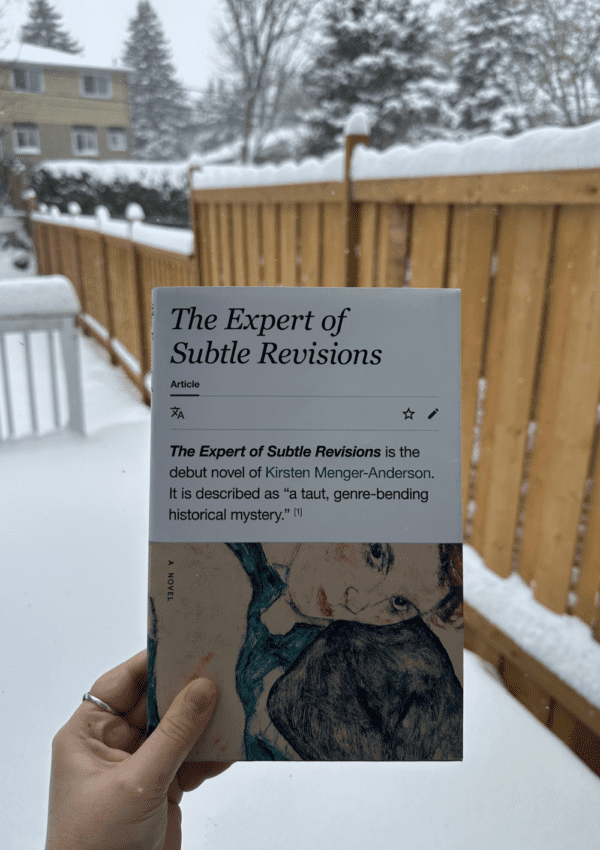
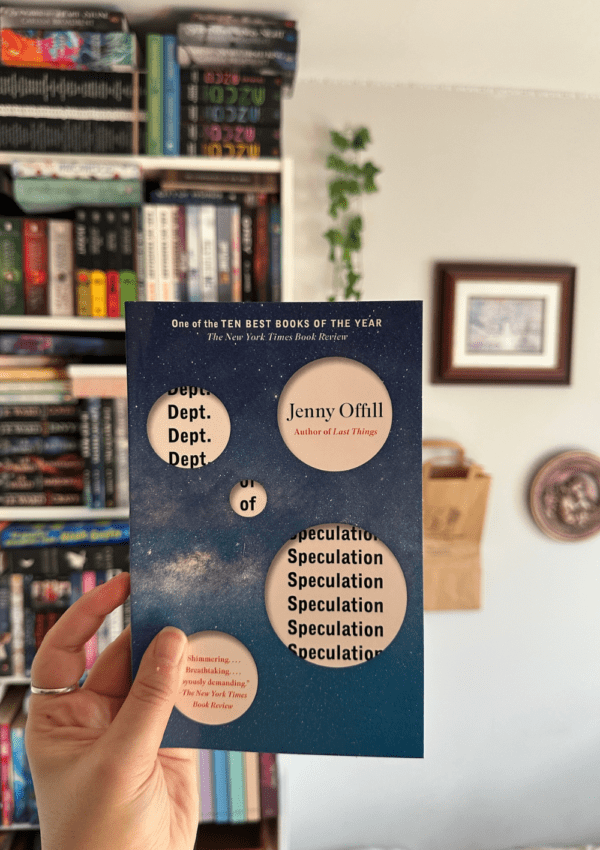
[…] Heck, I even read a whole book about women writers’ lives and marriages in “A Life of One’s Own” by Joanna Biggs. (You can read that review here.) […]