
This post may contain affiliate links, which means I’ll receive a commission if you purchase through my links, at no extra cost to you. Please read my full disclosure for more information.
“Bread of Angels” is a memoir that explores Patti Smith’s genesis, from her early artistic admirations and storytelling inclinations to the arduous path she’s trekked personally and artistically throughout her life and career. Patti Smith has stayed true to her bohemian roots amid poverty, great loss, and political turmoil.
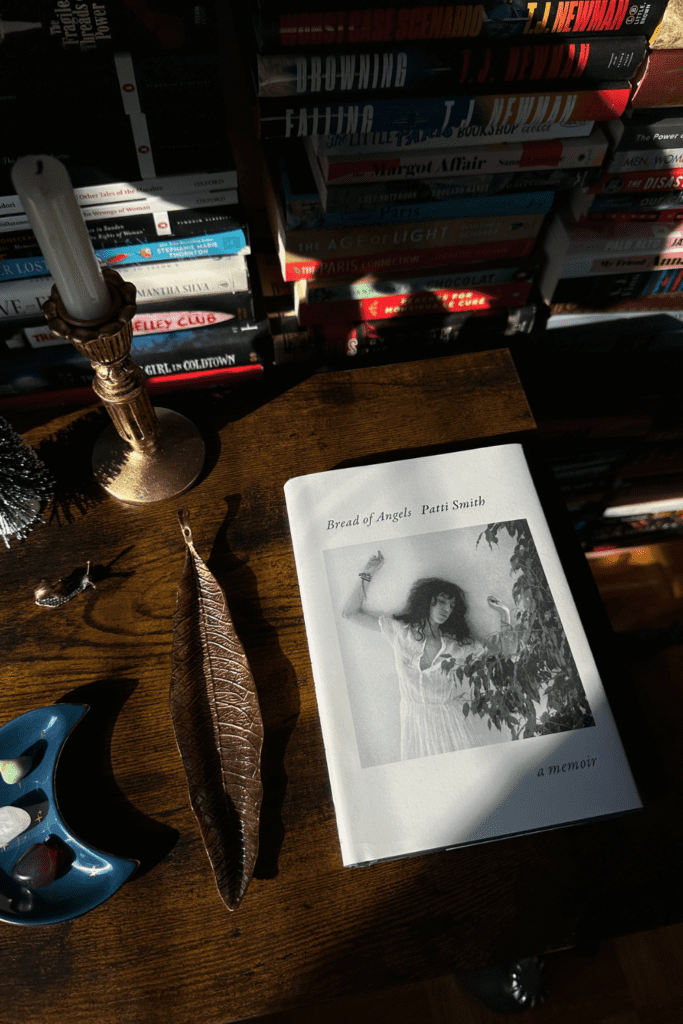
- Date finished: February 27th, 2026
- Pages: 276
- Format: Hardback
- Form: Non-Fiction
- Language read: English
- Series: Standalone
- Genre: Memoir | Music | Biography
“Bread of Angels” is a memoir that explores Patti Smith’s genesis, from her early artistic admirations and storytelling inclinations to the arduous path she’s trekked personally and artistically throughout her life and career. Patti Smith has stayed true to her bohemian roots amid poverty, great loss, and political turmoil.
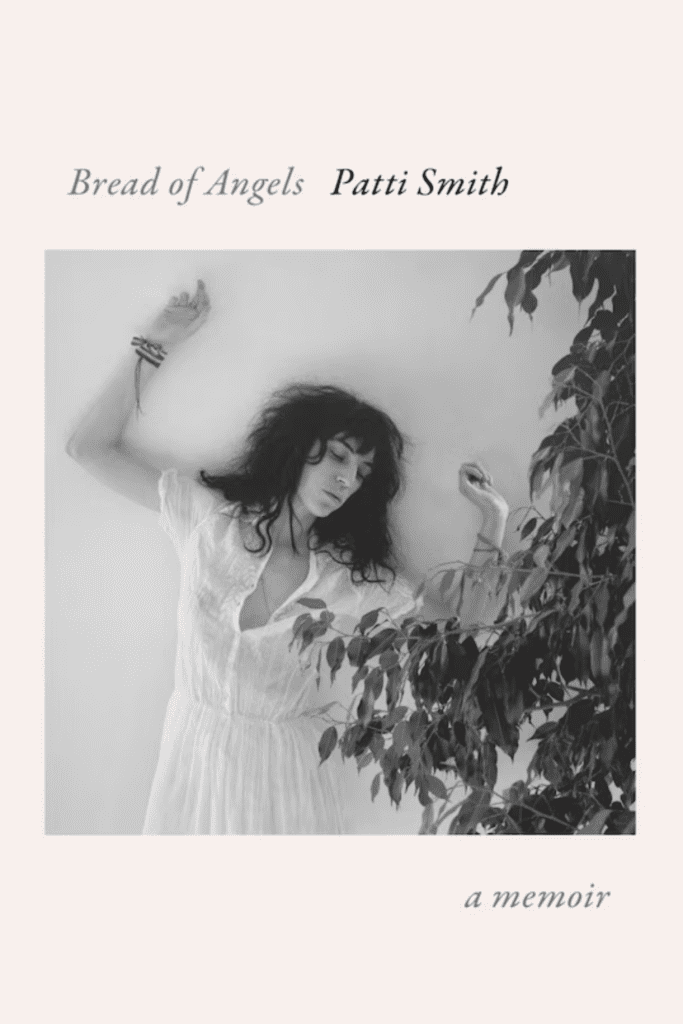
“Bread of Angels” was one of my most anticipated reads.
It’s quite difficult to review a memoir. Patti Smith has lived quite the life of the artist — musician, poet, writer, and so on. So instead, I will talk about my favourite parts and passages.
My favourite section consisted of Patti Smith’s childhood years, where she first introduces to the reader the notion of her ‘rebel hump,’ a rebellious streak that would grow, blossom, and transform her into the artist-activist we know of today.
I always believed in the magical properties of things. Before I had speech, I grasped for them. I believed there was a mystery woven in the threads of the scapular that I would solve. I imagined wearing it would augment my prayers. As always, I kept these things to myself, trying to appear indifferent. (p. 38)
At 19, she left college and gave birth to a baby girl, whom she gave up for adoption. She then proceeded to the big city (New York) to live the artist life with no money, no job, and no connection. These autobiographical facts are already well known as they were recounted in her memoir “Just Kids.”
Furthermore, Patti Smith and her family grew up poor in a post–World War II Philadelphia. We witness children dying of consumption, disappearing neighbours, and rat-infested housing complexes. And yet, Patti Smith prevails. Early in life, she will have a deep imaginative fire within that will sustain her through continuous tragedy and loss. First, she loses Robert Mappelthorpe (March 9th, 1989), her first love and best friend, who died of AIDS, and then her husband of 14 years, Fred Sonic Smith (November 4th, 1994, on Robert’s birth day), followed shortly by her beloved younger brother Todd (December 4th, 1994).
One thing I was certain of, I would prevail. I would be like Jo March, who drew from the fever of her imagination to tell stories. She lost her dear sister Beth to complications from scarlet fever and wrote a classic in her memory. Reading Little Women, I mourned Beth, I also knew I was not her. I would keep going, though I hadn’t imagined that one day, like Jo March, I would pick up my pen to write. (p. 48)
Undoubtedly, Patti Smith has had a full life and demonstrates her tenacity through the seasons of personal and collective grief. Reading this memoir, I am reminded that although times have greatly changed, and technology has evolved beyond our greatest imagination, we are still faced by the same problems humanity has always faced: loss, grief, wars, healthcare crises, the plights of the struggling artists, artists and the people united for peace and social justice causes, etc.
I SAT ON MY STOOP in New York and reread a poem in The Chimeras by Nerval that I had particularly loved when young. At the time I likened it to the image of a tarot card, the fallen tower, that drew me into its desolate atmosphere. Now it read with a relatable clarity; I am that widowed one, no one stands watch in my turret and my shoulder bears the poet’s melancholy mark. I looked down the street toward an emptiness where twin towers stood only a year ago. 2001, the Kubrick year. What monolith would we now celebrate? The phone rang, my reverie was broken, I had a feeling it was my mother’s daily call. (p. 215)
Admittedly, as a writer myself, my favourite parts were of Patti Smith’s reflections on the mission of the artist interwoven with her personal experiences, her ‘bread[s] of angels’ as she calls it:
One day I chanced upon The Selfish Giant by Oscar Wilde, strangely listed in Children’s Digest as a fairy tale. It was not like any other I had read. I had the same shock of aesthetic recognition that I had experienced with the photographs in Vogue, the poems by Yeats, and the paintings of Picasso. I read it over and over, trying to garner his uniqueness. And then it struck me: Everything was a potential poem. The stoic prayers of the mantis, the knowing eyes of my dog, the pen scratching. The white snake stirred, and the invisible lines of the rebel hump flickered then shimmered like the coat of many colors. (p. 82)
This is what the writer craves, in a café in the earliest hours, in an empty drawing room of a hotel, or scrawling in a notebook in the pew of a silent cathedral. A sudden shaft of brightness containing the vibration of a particular moment. Johnny Stahl tying my bootlace. Butchy Magic’s fingers extracting the stinger. The unsullied memory of unpremeditated gestures of kindness. These are the bread of angels. The pen drops, I touch phantom wounds. The boys from Philly never returned. By the time I was fifteen the face of another pervaded my furtive fantasies. The angels served a new portion; I discovered Arthur Rimbaud. (p. 85)
Consider the labor of the material visionary. A mathematician’s sudden moment of insight, an incontestable equation that nonetheless must be proved, setting in motion the gruelling process of formulating the abstract. The artist stabilizes an aspect of the flow of metamorphosis, to freeze as a work of art. Da Vinci’s Last Supper, Piero della Francesca’s The Legend of the True Cross, or Blue Poles by Jackson Pollock. We enter the psyche of the process by observing then surrendering to the artist’s articulated vision. (p. 245)
I agree with most of the “critiques” online. The chapters with her true love, Fred Sonic Smith, were quite rushed. Although I did love reading about the travels they undertook together and the joyful years they spent. Basically, anything after her childhood years seems to be skimmed, possibly because she’s lived quite a momentous and adventurous life. Similar to “Just Kids,” there’s a lot of name-dropping in this memoir that mostly did nothing for me, except when I recognized an artist she wrote about.
I’ve been reading and following Patti Smith’s Substack newsletter for a while now, so I’ve seen her travel vlogs, her touring (I even got to see her perform live in Toronto back in 2023 when she opened for ‘The National’), and the books and favourite authors (Oscar Wilde, Jean Genet, and of course Arthur Rimbaud) she shares.
All of this to say, whatever she writes, I will pick up and read. I selfishly hope to see a novel from her next.
We wage the fever of disappointment, the realization that yesterday’s crumbling tower was not a fantasy, that like the Prince of Aquitaine one is hurled and drawn like a human tarot card. How can we leap back up? Get back on our feet, grab a cart, and start gathering the debris, both physical and emotional. Crush it into small stones, then pulverize them and as the dust settles, dance upon it. How do we do that? By returning to our child self, weathering our obstacles in good faith. For children operate in the perpetual present, they go on, rebuild their castles, lay down their casts and crutches, and walk again. (p. 227)
In Sun and Steel Yukio Mishima speaks of the lust for ascension. It is encased in his poem Icarus. Perhaps he is speaking of the lust for illumination, possibly the artist’s greatest sin. Like the architects of Babel attempting to reach the realm of God, to penetrate and bathe in it, eat of it. Not satisfied with the beauty of the natural world, the artist seeks the unnatural kingdom, the kingdom of the mind, plucking from higher realms and revealing the components of Cubism, or the notes of an unfathomable fugue. In this way, one could say that Eve, seeking knowledge, was potentially the first artist. And what did she create? The good of Abel, the evil of Cain. There is magnificence, and there is magnificent failure. Perhaps that is what drew Mishima to Icarus, the hubris to challenge the Sun. The artist seeks paradise in life, he seeks what must not be sought. (p. 261)
⭐⭐⭐⭐
Leave a Reply